


Page 20 - Bisiness Studies
P. 20
Business Studies for Secondary Schools


           the community, develop business ideas, and take personal responsibility and initiatives to
           start and run a business. The business opportunities can either be created or discovered
           and used by individuals who have unique mental abilities and attitudes for profi t making.


           Types of entrepreneurship
          FOR ONLINE READING ONLY
           Entrepreneurship is classifi ed differently by various scholars. However, in this text book,
           three types of entrepreneurship are explained. These are business entrepreneurship,
           intrapreneurship or corporate entrepreneurship, and social entrepreneurship. These
           types cover the fundamentals of starting a business and focus more on the business
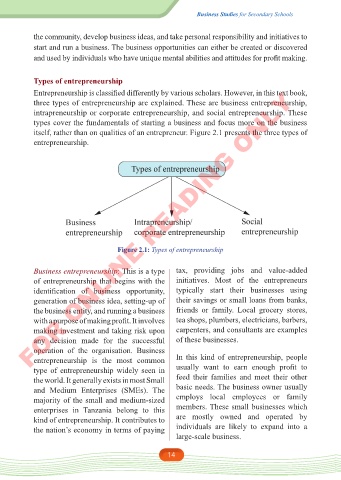
           itself, rather than on qualities of an entrepreneur. Figure 2.1 presents the three types of
           entrepreneurship.


                                     Figure 2.1: Types of entrepreneurship


           Business entrepreneurship: This is a type   tax,  providing  jobs  and  value-added
           of entrepreneurship that begins with the   initiatives.  Most of the entrepreneurs
           identifi cation  of  business  opportunity,   typically  start their businesses using
           generation of business idea, setting-up of   their savings or small loans from banks,
           the business entity, and running a business   friends or family. Local grocery stores,
           with a purpose of making profi t. It involves   tea shops, plumbers, electricians, barbers,
           making investment and taking risk upon     carpenters, and consultants are examples
           any decision made for the successful       of these businesses.
           operation of the organisation. Business
           entrepreneurship  is the  most common      In this kind of entrepreneurship, people
           type of entrepreneurship widely seen in    usually  want  to  earn  enough  profi t  to
           the world. It generally exists in most Small   feed their families and meet their other
           and  Medium  Enterprises  (SMEs).  The     basic needs. The business owner usually
           majority of the small and medium-sized     employs local  employees  or family
           enterprises in  Tanzania  belong to this   members. These small businesses which
           kind of entrepreneurship. It contributes to   are mostly owned and operated  by
           the nation’s economy in terms of paying    individuals  are likely  to expand into a
                                                      large-scale business.

                                                    14

