


Page 69 - Food And Human
P. 69
Form One


        FOR ONLINE READING ONLY


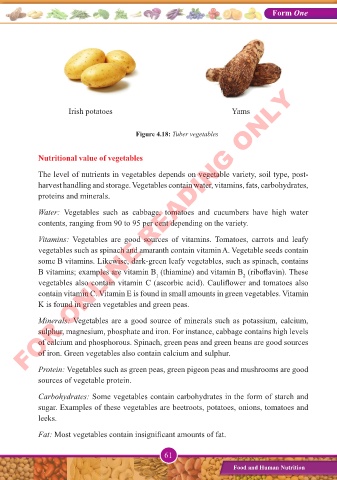
                           Irish potatoes                                                           Yams


                                         Figure 4.18: Tuber vegetables


            Nutritional value of vegetables

            The level of nutrients in vegetables depends on vegetable variety, soil type, post-
            harvest handling and storage. Vegetables contain water, vitamins, fats, carbohydrates,
            proteins and minerals.

            Water:  Vegetables  such as cabbage,  tomatoes  and cucumbers have  high  water
            contents, ranging from 90 to 95 per cent depending on the variety.

            Vitamins:  Vegetables  are  good sources of  vitamins. Tomatoes, carrots  and  leafy
            vegetables such as spinach and amaranth contain vitamin A. Vegetable seeds contain
            some B vitamins. Likewise, dark-green leafy vegetables, such as spinach, contains
            B vitamins; examples are vitamin B  (thiamine) and vitamin B  (ribofl avin). These
                                               1
                                                                         2
            vegetables also contain vitamin C (ascorbic acid). Caulifl ower and tomatoes also
            contain vitamin C. Vitamin E is found in small amounts in green vegetables. Vitamin
            K is found in green vegetables and green peas.

            Minerals: Vegetables are a good source of minerals such as potassium, calcium,
            sulphur, magnesium, phosphate and iron. For instance, cabbage contains high levels
            of calcium and phosphorous. Spinach, green peas and green beans are good sources
            of iron. Green vegetables also contain calcium and sulphur.

            Protein: Vegetables such as green peas, green pigeon peas and mushrooms are good
            sources of vegetable protein.

            Carbohydrates: Some vegetables contain carbohydrates in the form of starch and
            sugar. Examples of these vegetables are beetroots, potatoes, onions, tomatoes and
            leeks.

            Fat: Most vegetables contain insignifi cant amounts of fat.


                                                  61

                                                                      Food and Human Nutrition


                                                                                          18/10/2024   18:26
   FOOD AND HUMAN NUTRITION  F1.indd   61                                                 18/10/2024   18:26
   FOOD AND HUMAN NUTRITION  F1.indd   61

