


Page 80 - Food And Human
P. 80
Form One


            (iii)   Constant  attention  is required  to ensure that  the  water  is continuously
                 boiling and replenished as required.

            (iv)   It can be costly. While steaming can be done using basic kitchen tools like
                 a steamer basket or improvised setups, some people may prefer dedicated
                 steamers (electric or stovetop), which can be an additional cost.
        FOR ONLINE READING ONLY
            (v)  Steaming may not add signifi cant fl avour to cooked food, unlike roasting or
                 grilling, which impart a smoky fl avour.

            (vi)   Steamed dishes may lack the crispiness or textural variety found in dishes
                 prepared using other methods, such as frying and baking.
            (vii)  Care must be taken not to overcook delicate ingredients, as steaming can
                 quickly turn them mushy and negatively affect their appearance and taste.


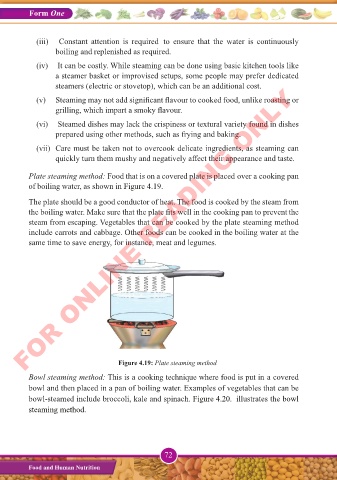
          Plate steaming method: Food that is on a covered plate is placed over a cooking pan
          of boiling water, as shown in Figure 4.19.

          The plate should be a good conductor of heat. The food is cooked by the steam from
          the boiling water. Make sure that the plate fi ts well in the cooking pan to prevent the
          steam from escaping. Vegetables that can be cooked by the plate steaming method
          include carrots and cabbage. Other foods can be cooked in the boiling water at the
          same time to save energy, for instance, meat and legumes.


                                    Figure 4.19: Plate steaming method
          Bowl steaming method: This is a cooking technique where food is put in a covered
          bowl and then placed in a pan of boiling water. Examples of vegetables that can be
          bowl-steamed include broccoli, kale and spinach. Figure 4.20.  illustrates the bowl
          steaming method.


                                                  72

          Food and Human Nutrition


                                                                                          18/10/2024   18:26
   FOOD AND HUMAN NUTRITION  F1.indd   72
   FOOD AND HUMAN NUTRITION  F1.indd   72                                                 18/10/2024   18:26

