


Page 77 - Sports_Studies_Form_1
P. 77
Sport Studies for Secondary Schools


           The 4x100 m relay
           In 4x100 m relay, the first runner in a team is required to cover a 100 m distance
           while holding a baton before passing it to the second runner. The second runner
           will also cover a 100 m distance, the same to the third runner, as well as the fourth
           runner and completes the race. The 4x100 m requires an athlete to sprint at top
          FOR ONLINE READING ONLY
           speed throughout the race. The non-visual baton exchange is commonly used in
           this race.

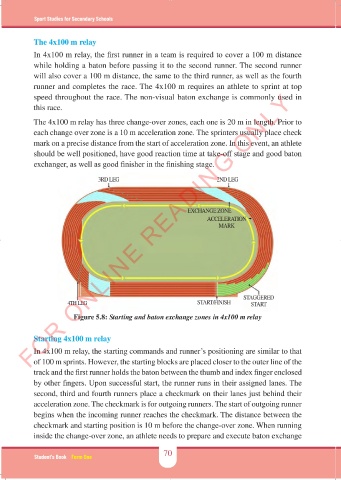
           The 4x100 m relay has three change-over zones, each one is 20 m in length. Prior to
           each change over zone is a 10 m acceleration zone. The sprinters usually place check
           mark on a precise distance from the start of acceleration zone. In this event, an athlete
           should be well positioned, have good reaction time at take-off stage and good baton
           exchanger, as well as good finisher in the finishing stage.

                               3RD LEG                             2ND LEG


                                                          EXCHANGE ZONE
                                                                ACCELERATION
                                                                   MARK


                                                                           STAGGERED
                     4TH LEG                                 START/FINISH    START

                       Figure 5.8: Starting and baton exchange zones in 4x100 m relay


           Starting 4x100 m relay
           In 4x100 m relay, the starting commands and runner’s positioning are similar to that
           of 100 m sprints. However, the starting blocks are placed closer to the outer line of the
           track and the first runner holds the baton between the thumb and index finger enclosed
           by other fingers. Upon successful start, the runner runs in their assigned lanes. The
           second, third and fourth runners place a checkmark on their lanes just behind their
           acceleration zone. The checkmark is for outgoing runners. The start of outgoing runner
           begins when the incoming runner reaches the checkmark. The distance between the
           checkmark and starting position is 10 m before the change-over zone. When running
           inside the change-over zone, an athlete needs to prepare and execute baton exchange

                                                  70
           Student's Book    Form One


                                                                                          05/12/2024   13:17:51
     SPORTS STUDIES FORM ONE.indd   70                                                    05/12/2024   13:17:51
     SPORTS STUDIES FORM ONE.indd   70

