


Page 104 - Textile
P. 104
Textiles and Garment Construction

           way. A pleat is used as a design on garments, household items or other accessories.
           Pleats are also functional as they give fullness to skirts, dresses, shorts and trousers.
           Pleats are suitable for both fine and medium weight fabrics. They are formed by folding
           the fabric to create three overlapping layers. One pleat requires three times its finished
           width. For example, if the finished pleat's width is 0.5cm, the amount of material
           required to make the pleat is 1.5cm. Good pleats are acquired by folding and pressing
           them before pinning and stitching to make them hang evenly and straight.

           Types of pleats

           Several types of pleats are available in different clothes, including knife, box, inverted
           and kick pleats. In this section, the procedure for working out the common pleats is
           discussed:

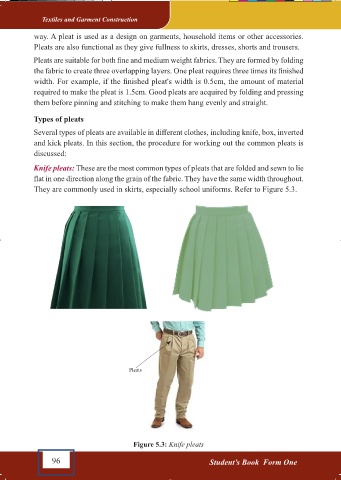
           Knife pleats: These are the most common types of pleats that are folded and sewn to lie
           flat in one direction along the grain of the fabric. They have the same width throughout.
           They are commonly used in skirts, especially school uniforms. Refer to Figure 5.3.


                                        Pleats


                                         Figure 5.3: Knife pleats

                 96                                             Student’s Book  Form One                          Student’s Book  Form One                                               97


                                                                                          20/10/2024   16:47:43
     BOOK TEXTILE  FINAL FINAL 20.10.2024.indd   96
     BOOK TEXTILE  FINAL FINAL 20.10.2024.indd   96                                       20/10/2024   16:47:43

