


Page 134 - Textile
P. 134
Textiles and Garment Construction

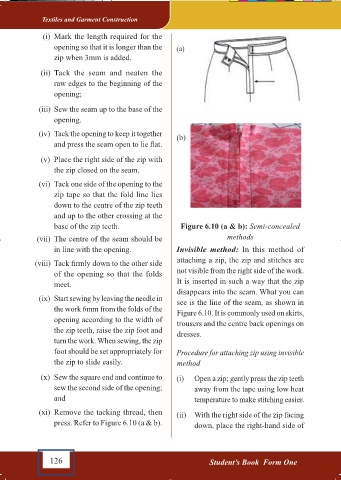
                (i)   Mark the length required for the
                 opening so that it is longer than the   (a)
                 zip when 3mm is added.

               (ii)   Tack the seam and neaten the
                 raw edges to the beginning of the
                 opening;

              (iii)   Sew the seam up to the base of the
                 opening.
              (iv)   Tack the opening to keep it together   (b)
                 and press the seam open to lie flat.

               (v)   Place the right side of the zip with
                 the zip closed on the seam.

              (vi)   Tack one side of the opening to the
                 zip tape so that the fold line lies
                 down to the centre of the zip teeth
                 and up to the other crossing at the
                 base of the zip teeth.                 Figure 6.10 (a & b): Semi-concealed
             (vii)   The centre of the seam should be                 methods
                 in line with the opening.            Invisible method: In this method of

            (viii)   Tack firmly down to the other side   attaching a zip, the zip and stitches are
                 of the opening so that the folds      not visible from the right side of the work.
                 meet.                                 It is inserted in such a way that the zip
                                                       disappears into the seam. What you can
              (ix)   Start sewing by leaving the needle in   see is the line of the seam, as shown in
                 the work 6mm from the folds of the    Figure 6.10. It is commonly used on skirts,
                 opening according to the width of     trousers and the centre back openings on
                 the zip teeth, raise the zip foot and   dresses.
                 turn the work. When sewing, the zip
                 foot should be set appropriately for   Procedure for attaching zip using invisible
                 the zip to slide easily.              method

               (x)   Sew the square end and continue to   (i)     Open a zip; gently press the zip teeth
                 sew the second side of the opening;        away from the tape using low heat
                 and                                        temperature to make stitching easier.

              (xi)   Remove the tacking thread, then   (ii)   With the right side of the zip facing
                 press. Refer to Figure 6.10 (a & b).       down, place the right-hand side of


                126                                             Student’s Book  Form One                          Student’s Book  Form One                                              127


                                                                                          20/10/2024   16:47:58
     BOOK TEXTILE  FINAL FINAL 20.10.2024.indd   126                                      20/10/2024   16:47:58
     BOOK TEXTILE  FINAL FINAL 20.10.2024.indd   126

