


Page 179 - Textile
P. 179
Textiles and Garment Construction

           of the fabric. However, the fabric with        together, and match the selvedge
           stripes, plaids and prints should be folded    ends. This is suitable for fabrics with
           with the wrong sides facing each other to      patterns running in the same direction
           help match the fabric design.                  or reversible fabric. Refer to Figure
           An open layout may be used where the           9.7.
           fabric has to be spread on a table without
           folding it and pattern pieces placed on the
           fabric from left to right, one after another.
           When cutting a single layer of fabric, the
           right side should be out. It is important to
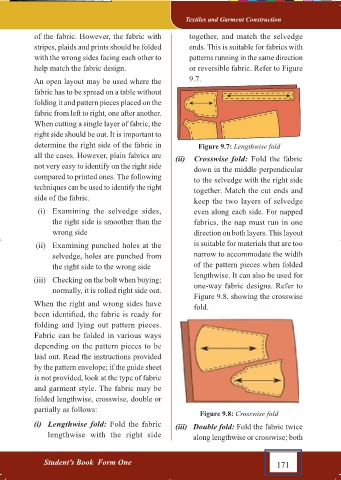
           determine the right side of the fabric in         Figure 9.7: Lengthwise fold
           all the cases. However, plain fabrics are   (ii)   Crosswise fold: Fold the fabric
           not very easy to identify on the right side      down in the middle perpendicular
           compared to printed ones. The following          to the selvedge with the right side
           techniques can be used to identify the right     together. Match the cut ends and
           side of the fabric.                              keep the two layers of selvedge

             (i)   Examining the selvedge sides,            even along each side. For napped
                 the right side is smoother than the        fabrics, the nap must run in one
                 wrong side                                 direction on both layers. This layout
            (ii)   Examining punched holes at the           is suitable for materials that are too
                 selvedge, holes are punched from           narrow to accommodate the width
                 the right side to the wrong side           of the pattern pieces when folded

           (iii)   Checking on the bolt when buying;        lengthwise. It can also be used for
                 normally, it is rolled right side out.     one-way fabric designs. Refer to
                                                            Figure 9.8, showing the crosswise
           When the right and wrong sides have              fold.
           been identified, the fabric is ready for
           folding and lying out pattern pieces.
           Fabric can be folded in various ways
           depending on the pattern pieces to be
           laid out. Read the instructions provided
           by the pattern envelope; if the guide sheet
           is not provided, look at the type of fabric
           and garment style. The fabric may be
           folded lengthwise, crosswise, double or
           partially as follows:
                                                             Figure 9.8: Crosswise fold
           (i)   Lengthwise fold: Fold the fabric     (iii)   Double fold: Fold the fabric twice
               lengthwise with the right side              along lengthwise or crosswise; both


 170  Student’s Book  Form One  Student’s Book  Form One                             171


                                                                                          20/10/2024   16:48:16
     BOOK TEXTILE  FINAL FINAL 20.10.2024.indd   171                                      20/10/2024   16:48:16
     BOOK TEXTILE  FINAL FINAL 20.10.2024.indd   171

