


Page 60 - Textile
P. 60
Textiles and Garment Construction

               (v)   When working out hand stitches,             stitches onto the needle before
                  work one stitch at a time for an               pulling it through.   When
                  efficient work;                                working this stitch, allow the
                                                                 main part of the fabric to hang
             (vi)   Wear a thimble on the middle finger
                  of the hand holding the fabric when            down from the hand.
                  sewing to prevent the fingertip from      (b)   Long and short tacking: This
                  injuring while pushing the needle              stitch is particularly useful for
                  through the garment or fabric;                 heavier materials, as it holds

            (vii)   When threading a needle for                  more layers firmly and works
                                                                 more quickly than even tacking.
                  sewing,  use  single  or  double               Stitch one long stitch, then a
                  thread depending on the activity;              short stitch; repeat the process
                  for example, thread marking stitch             to have long and short stitches
                  uses double threads and;                       with even distances.
           (viii)   The thread used should not be too
                  long because it may cause knots.     Procedure for working on even, short and
                                                       long tacking stitches
           Classification of stitches                    (i)   Prepare two pieces of fabric to work

           Stitches are classified based on structural,     on the stitches. It is recommended to
           decorative and functional purposes. It           cut a piece of fabric of 12cm width
           can also classified as temporary, joining,       12cm length;
           neatening and  embroidery  stitches  as      (ii)    Make a first and a second fold on
           discussed here:                                   one edge of each piece of fabric;
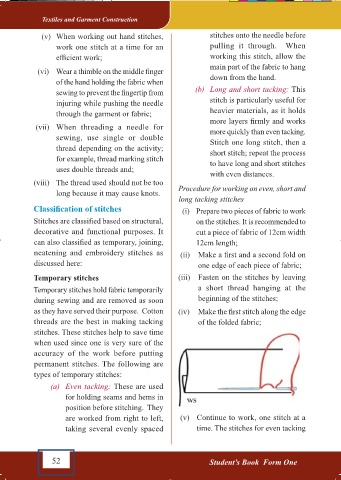
           Temporary stitches                          (iii)    Fasten on the stitches by leaving

           Temporary stitches hold fabric temporarily        a short thread hanging at the
           during sewing and are removed as soon             beginning of the stitches;
           as they have served their purpose.  Cotton   (iv)    Make the first stitch along the edge
           threads are the best in making tacking            of the folded fabric;
           stitches. These stitches help to save time
           when used since one is very sure of the
           accuracy of the work before putting
           permanent stitches. The following are
           types of temporary stitches:
                (a)  Even tacking: These are used
                     for holding seams and hems in
                     position before stitching.  They
                     are worked from right to left,     (v)    Continue to work, one stitch at a
                     taking several evenly spaced            time. The stitches for even tacking


                 52                                             Student’s Book  Form One                          Student’s Book  Form One                                               53


                                                                                          20/10/2024   16:47:19
     BOOK TEXTILE  FINAL FINAL 20.10.2024.indd   52                                       20/10/2024   16:47:19
     BOOK TEXTILE  FINAL FINAL 20.10.2024.indd   52

