


Page 61 - Textile
P. 61
Textiles and Garment Construction

                 should be 10 mm long on both the
                 right and wrong sides. For long and    (iii)   Using a coloured pen or marker
                 short tacking, make one short stitch        pen, label the prototype clearly to
                 5 mm long, then another 10 mm               indicate the type of stitch you have
                 long and continue in this pattern to        worked on. Arrange the prototype
                 the end;                                    according to their classification.
                                                        (iv)    Punch holes in the manila card
                                                              and place them in the portfolio.


                                  WS
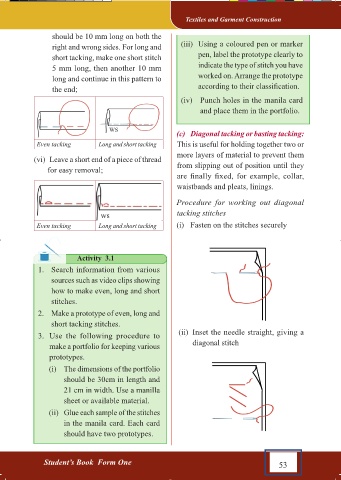
                                                      (c)  Diagonal tacking or basting tacking:
            Even tacking       Long and short tacking  This is useful for holding together two or
                                                       more layers of material to prevent them
           (vi)     Leave a short end of a piece of thread
               for easy removal;                       from slipping out of position until they
                                                       are finally fixed, for example, collar,
                                                       waistbands and pleats, linings.

                                                      Procedure for working out diagonal

                                ws                     tacking stitches
            Even tacking       Long and short tacking  (i)  Fasten on the stitches securely


                        Activity  3.1
             1.    Search information from various
                 sources such as video clips showing
                 how to make even, long and short
                 stitches.
             2.    Make a prototype of even, long and
                 short tacking stitches.
             3.   Use the following procedure to       (ii)   Inset the needle straight, giving a
                make a portfolio for keeping various       diagonal stitch
                prototypes.

                (i)   The dimensions of the portfolio
                    should be 30cm in length and
                    21 cm in width. Use a manilla
                    sheet or available material.
                (ii)   Glue each sample of the stitches
                    in the manila card. Each card
                    should have two prototypes.


 52  Student’s Book  Form One  Student’s Book  Form One                              53


                                                                                          20/10/2024   16:47:20
     BOOK TEXTILE  FINAL FINAL 20.10.2024.indd   53                                       20/10/2024   16:47:20
     BOOK TEXTILE  FINAL FINAL 20.10.2024.indd   53

