


Page 66 - Textile
P. 66
Textiles and Garment Construction

                                                      invisible on the right side of the fabric.
                                                      The edge of the stitch should be held
                                                      towards the worker. Hemming stitches
                                                      can be worked in different ways, such as
                                                      slant, vertical, or slip hemming.
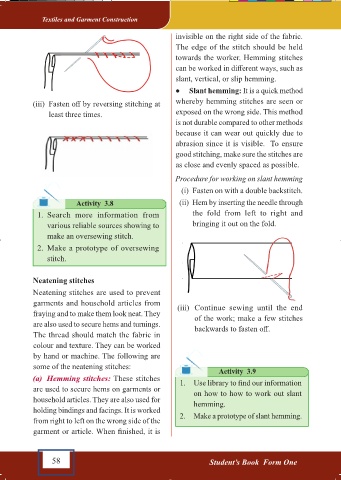
                                                      ●  Slant hemming: It is a quick method
           (iii)   Fasten off by reversing stitching at   whereby hemming stitches are seen or
                least three times.                    exposed on the wrong side. This method
                                                      is not durable compared to other methods
                                                      because it can wear out quickly due to
                                                      abrasion since it is visible.  To ensure
                                                      good stitching, make sure the stitches are
                                                      as close and evenly spaced as possible.

                                                      Procedure for working on slant hemming
                                                         (i)  Fasten on with a double backstitch.
                        Activity  3.8                   (ii)   Hem by inserting the needle through

            1.   Search more information from              the  fold from  left  to  right and
               various reliable sources showing to         bringing it out on the fold.
               make an oversewing stitch.
            2.   Make a prototype of oversewing
               stitch.


           Neatening stitches
           Neatening stitches are used to prevent
           garments and household articles from        (iii)    Continue sewing until the end
           fraying and to make them look neat. They         of the work; make a few stitches
           are also used to secure hems and turnings.       backwards to fasten off.
           The thread should match the fabric in
           colour and texture. They can be worked
           by hand or machine. The following are
           some of the neatening stitches:                         Activity  3.9
           (a)  Hemming stitches: These stitches       1.   Use library to find our information
           are used to secure hems on garments or           on how to how to work out slant
           household articles. They are also used for       hemming.
           holding bindings and facings. It is worked
           from right to left on the wrong side of the   2.  Make a prototype of slant hemming.
           garment or article. When finished, it is


                 58                                             Student’s Book  Form One                          Student’s Book  Form One                                               59


                                                                                          20/10/2024   16:47:25
     BOOK TEXTILE  FINAL FINAL 20.10.2024.indd   58
     BOOK TEXTILE  FINAL FINAL 20.10.2024.indd   58                                       20/10/2024   16:47:25

