


Page 86 - Textile
P. 86
Textiles and Garment Construction

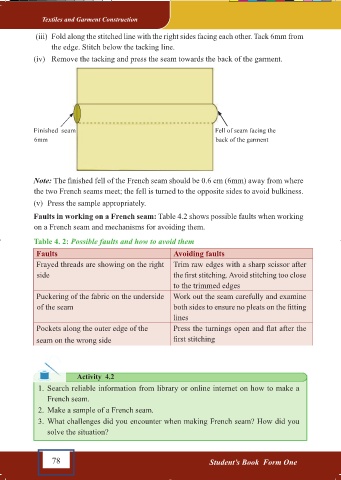
            (iii)   Fold along the stitched line with the right sides facing each other. Tack 6mm from
                 the edge. Stitch below the tacking line.
           (iv)   Remove the tacking and press the seam towards the back of the garment.


           Finished seam                                          Fell of seam facing the
           6mm                                                    back of the garment


           Note: The finished fell of the French seam should be 0.6 cm (6mm) away from where
           the two French seams meet; the fell is turned to the opposite sides to avoid bulkiness.
           (v)  Press the sample appropriately.

           Faults in working on a French seam: Table 4.2 shows possible faults when working
           on a French seam and mechanisms for avoiding them.
           Table 4. 2: Possible faults and how to avoid them

            Faults                                    Avoiding faults
            Frayed threads are showing on the right   Trim raw edges with a sharp scissor after
            side                                     the first stitching. Avoid stitching too close
                                                     to the trimmed edges
            Puckering of the fabric on the underside  Work out the seam carefully and examine
            of the seam                              both sides to ensure no pleats on the fitting
                                                     lines
            Pockets along the outer edge of the       Press the turnings open and flat after the
            seam on the wrong side                   first stitching


                        Activity  4.2
             1.   Search reliable information from library or online internet on how to make a
               French seam.
             2.  Make a sample of a French seam.
             3.   What challenges did you encounter when making French seam? How did you
               solve the situation?


                 78                                             Student’s Book  Form One                          Student’s Book  Form One                                               79


                                                                                          20/10/2024   16:47:35
     BOOK TEXTILE  FINAL FINAL 20.10.2024.indd   78                                       20/10/2024   16:47:35
     BOOK TEXTILE  FINAL FINAL 20.10.2024.indd   78

