


Page 14 - Thietre Arts
P. 14
Theatre Arts For Secondary Schools

          Roles of costumes

          Apart from other garments or clothes, costumes serve as a powerful channel of
          expression, identity and cultural reflection. The roles that costumes play within lives
          and society are to:
            (a)  Enable one to identify the time which the performance was set. The time may
                involve different seasons or types of weather, such as rainy, sunny or cold.
                Therefore, the costumes used in the performance should reflect such periods.
                For instance, costumes such as sweaters and light clothes suggest weather
                conditions while track suits suggest sports gear.
            (b)  Help in telling the story and simplifying messages to the audience.
            (c)  Help actors get into characters and they tell the audience something about
                what is going on.

            (d)  Help one to identify and differentiate gender and characters. For example, a
                female from a male, a banker from a farmer, a doctor from a nurse, a grandmother
                from a young woman and the like.
            (e)  Help to describe age of the performer. Audience can easily know if the
                performer plays a role of an old person or young ones through their dressing
                during performance.

          Props

          These are items used by performers during a theatrical performance. Props are also
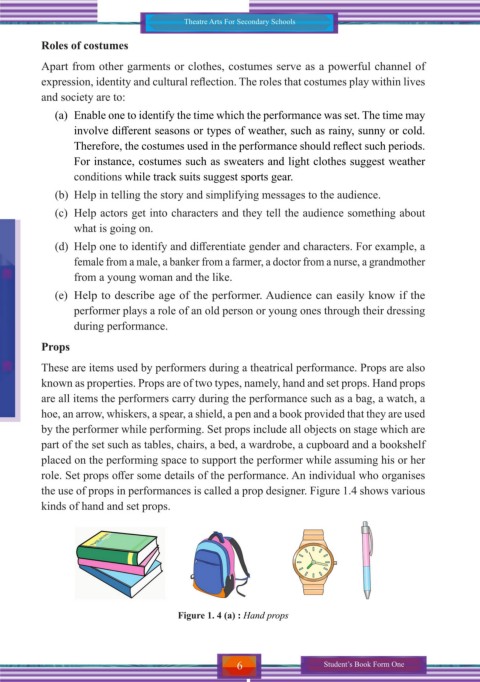
          known as properties. Props are of two types, namely, hand and set props. Hand props
          are all items the performers carry during the performance such as a bag, a watch, a
          hoe, an arrow, whiskers, a spear, a shield, a pen and a book provided that they are used
          by the performer while performing. Set props include all objects on stage which are
          part of the set such as tables, chairs, a bed, a wardrobe, a cupboard and a bookshelf
          placed on the performing space to support the performer while assuming his or her
          role. Set props offer some details of the performance. An individual who organises
          the use of props in performances is called a prop designer. Figure 1.4 shows various
          kinds of hand and set props.


                                      Figure 1. 4 (a) : Hand props


                                                  6                 Student’s Book Form One


                                                                                          18/10/2024   18:39
   Theatre arts form 1.indd   6
   Theatre arts form 1.indd   6                                                           18/10/2024   18:39

