


Page 25 - Agriculture_Form_3
P. 25
Agriculture for Secondary Schools


              mm or more is typically required. Maize grows in deep, loamy, well-aerated soils
              with good drainage, organic matter, and ample nutrients. The optimal soil pH for
              maize is 6.0 - 7.0; extreme acidity or alkalinity may cause nutrient deficiencies
              and mineral toxicity. Additionally, maize  requires full sunlight for maximum
              photosynthesis. So, shaded areas should be avoided to prevent yield reduction.
          FOR ONLINE READING ONLY
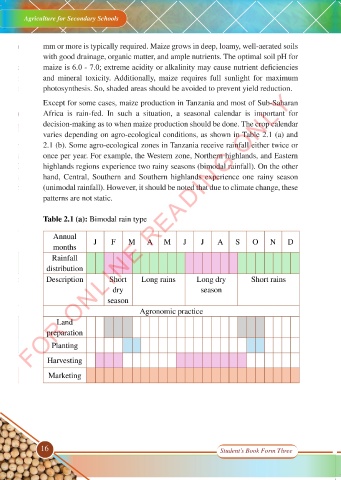
              Except for some cases, maize production in Tanzania and most of Sub-Saharan
              Africa is rain-fed.  In such a situation,  a seasonal calendar  is important  for
              decision-making as to when maize production should be done. The crop calendar
              varies depending on agro-ecological conditions, as shown in Table 2.1 (a) and
              2.1 (b). Some agro-ecological zones in Tanzania receive rainfall either twice or
              once per year. For example, the Western zone, Northern highlands, and Eastern
              highlands regions experience two rainy seasons (bimodal rainfall). On the other
              hand, Central, Southern and Southern highlands experience  one rainy season
              (unimodal rainfall). However, it should be noted that due to climate change, these
              patterns are not static.


              Table 2.1 (a): Bimodal rain type


                 Annual      J     F    M    A     M    J     J    A    S    O     N    D
                 months
                 Rainfall
               distribution
               Description        Short     Long rains       Long dry        Short rains
                                   dry                        season
                                  season
                                           Agronomic practice
                  Land
               preparation
                 Planting

               Harvesting

                Marketing


             16                                                     Student’s Book Form Three


                                                                                            17/09/2025   14:11
     AGRICULTURE F3.indd   16                                                               17/09/2025   14:11
     AGRICULTURE F3.indd   16

