


Page 35 - Agriculture_Form_3
P. 35
Agriculture for Secondary Schools


              Maize  lethal necrosis: Maize  Lethal  Necrosis (MLN) is a viral disease that
              causes yellowing and drying of the leaves. It also leads to poor plant growth and
              empty cobs, which causes a big loss in the harvest. The disease can be managed
              by planting maize varieties that resist MLN, controlling insect vectors such as
              thrips and aphids that spread the virus, and practising crop rotation with non-
          FOR ONLINE READING ONLY
              host crops. To reduce  the risk of spreading the disease, maize  should not be
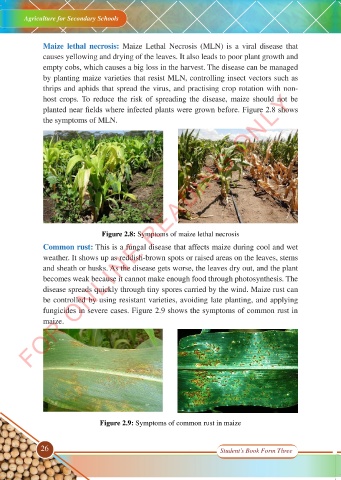
              planted near fields where infected plants were grown before. Figure 2.8 shows
              the symptoms of MLN.


                                Figure 2.8: Symptoms of maize lethal necrosis

              Common rust: This is a fungal disease that affects maize during cool and wet
              weather. It shows up as reddish-brown spots or raised areas on the leaves, stems
              and sheath or husks. As the disease gets worse, the leaves dry out, and the plant
              becomes weak because it cannot make enough food through photosynthesis. The
              disease spreads quickly through tiny spores carried by the wind. Maize rust can
              be controlled by using resistant varieties, avoiding late planting, and applying
              fungicides in severe cases. Figure 2.9 shows the symptoms of common rust in
              maize.


                               Figure 2.9: Symptoms of common rust in maize


             26                                                     Student’s Book Form Three


                                                                                            17/09/2025   14:11
     AGRICULTURE F3.indd   26                                                               17/09/2025   14:11
     AGRICULTURE F3.indd   26

