


Page 38 - Agriculture_Form_3
P. 38
Agriculture for Secondary Schools


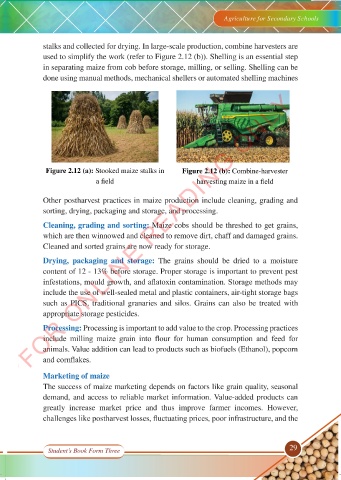
              stalks and collected for drying. In large-scale production, combine harvesters are
              used to simplify the work (refer to Figure 2.12 (b)). Shelling is an essential step
              in separating maize from cob before storage, milling, or selling. Shelling can be
              done using manual methods, mechanical shellers or automated shelling machines
          FOR ONLINE READING ONLY


               Figure 2.12 (a): Stooked maize stalks in   Figure 2.12 (b): Combine-harvester
                              a field                       harvesting maize in a field


              Other postharvest practices in maize production include cleaning, grading and
              sorting, drying, packaging and storage, and processing.

              Cleaning, grading and sorting: Maize cobs should be threshed to get grains,
              which are then winnowed and cleaned to remove dirt, chaff and damaged grains.
              Cleaned and sorted grains are now ready for storage.
              Drying, packaging and storage:  The  grains  should be  dried  to  a moisture
              content of 12 - 13% before storage. Proper storage is important to prevent pest
              infestations, mould growth, and aflatoxin contamination. Storage methods may
              include the use of well-sealed metal and plastic containers, air-tight storage bags
              such as PICS, traditional granaries and silos. Grains can also be treated with
              appropriate storage pesticides.

              Processing: Processing is important to add value to the crop. Processing practices
              include  milling  maize  grain  into  flour  for  human  consumption  and  feed  for
              animals. Value addition can lead to products such as biofuels (Ethanol), popcorn
              and cornflakes.

              Marketing of maize
              The success of maize marketing depends on factors like grain quality, seasonal
              demand, and access to reliable market information. Value-added products can
              greatly  increase  market  price  and thus improve  farmer incomes.  However,
              challenges like postharvest losses, fluctuating prices, poor infrastructure, and the


                Student’s Book Form Three                                                29


                                                                                            17/09/2025   14:11
     AGRICULTURE F3.indd   29                                                               17/09/2025   14:11
     AGRICULTURE F3.indd   29

