


Page 48 - Agriculture_Form_3
P. 48
Agriculture for Secondary Schools


              extract or soapy water, avoiding overcrowding to improve air circulation, and
              applying recommended insecticide under the advice of an agricultural extension
              worker. Figure 3.2 (c) shows the sorghum aphids.


          FOR ONLINE READING ONLY


                                       Figure 3.2 (c): Sorghum aphids

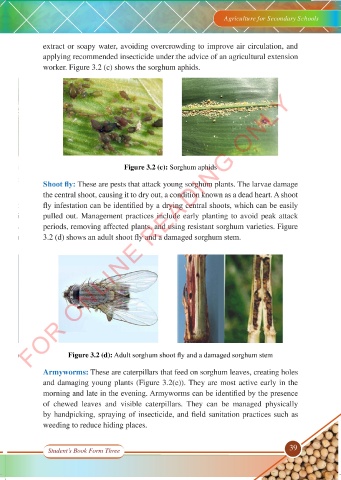
              Shoot fly: These are pests that attack young sorghum plants. The larvae damage
              the central shoot, causing it to dry out, a condition known as a dead heart. A shoot
              fly infestation can be identified by a drying central shoots, which can be easily
              pulled out. Management practices include early planting to avoid peak attack
              periods, removing affected plants, and using resistant sorghum varieties. Figure
              3.2 (d) shows an adult shoot fly and a damaged sorghum stem.


                      Figure 3.2 (d): Adult sorghum shoot fly and a damaged sorghum stem

              Armyworms: These are caterpillars that feed on sorghum leaves, creating holes
              and damaging young plants (Figure 3.2(e)). They are most active early in the
              morning and late in the evening. Armyworms can be identified by the presence
              of chewed leaves and visible caterpillars.  They can be managed  physically
              by handpicking, spraying of insecticide, and field sanitation practices such as
              weeding to reduce hiding places.


                Student’s Book Form Three                                                39


                                                                                            17/09/2025   14:11
     AGRICULTURE F3.indd   39                                                               17/09/2025   14:11
     AGRICULTURE F3.indd   39

