


Page 49 - Agriculture_Form_3
P. 49
Agriculture for Secondary Schools


          FOR ONLINE READING ONLY


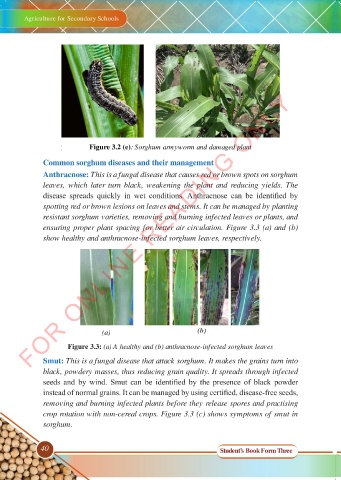
                            Figure 3.2 (e): Sorghum armyworm and damaged plant

              Common sorghum diseases and their management
              Anthracnose: This is a fungal disease that causes red or brown spots on sorghum
              leaves,  which  later  turn  black,  weakening  the  plant  and  reducing  yields. The
              disease  spreads  quickly  in  wet  conditions. Anthracnose  can  be  identified  by
              spotting red or brown lesions on leaves and stems. It can be managed by planting
              resistant sorghum varieties, removing and burning infected leaves or plants, and
              ensuring proper plant spacing for better air circulation. Figure 3.3 (a) and (b)
              show healthy and anthracnose-infected sorghum leaves, respectively.


                                (a)                          (b)
                      Figure 3.3: (a) A healthy and (b) anthracnose-infected sorghum leaves

              Smut: This is a fungal disease that attack sorghum. It makes the grains turn into
              black, powdery masses, thus reducing grain quality. It spreads through infected
              seeds  and  by  wind.  Smut  can  be  identified  by  the  presence  of  black  powder
              instead of normal grains. It can be managed by using certified, disease-free seeds,
              removing and burning infected plants before they release spores and practising
              crop rotation with non-cereal crops. Figure 3.3 (c) shows symptoms of smut in
              sorghum.


             40                                                     Student’s Book Form Three


                                                                                            17/09/2025   14:11
     AGRICULTURE F3.indd   40                                                               17/09/2025   14:11
     AGRICULTURE F3.indd   40

