


Page 53 - Agriculture_Form_3
P. 53
Agriculture for Secondary Schools


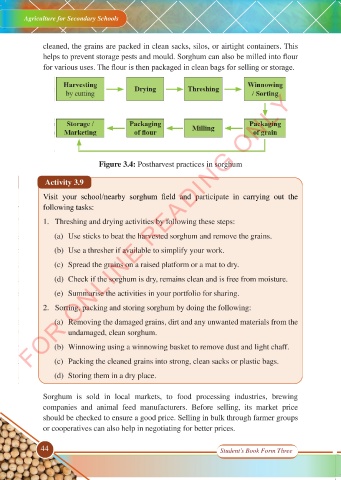
              cleaned, the grains are packed in clean sacks, silos, or airtight containers. This
              helps to prevent storage pests and mould. Sorghum can also be milled into flour
              for various uses. The flour is then packaged in clean bags for selling or storage.


          FOR ONLINE READING ONLY


                               Figure 3.4: Postharvest practices in sorghum

               Activity 3.9

              Visit  your  school/nearby  sorghum  field  and  participate  in  carrying  out  the
              following tasks:

              1.  Threshing and drying activities by following these steps:

                 (a)  Use sticks to beat the harvested sorghum and remove the grains.
                 (b)  Use a thresher if available to simplify your work.

                 (c)  Spread the grains on a raised platform or a mat to dry.

                 (d)  Check if the sorghum is dry, remains clean and is free from moisture.
                 (e)  Summarise the activities in your portfolio for sharing.

              2.  Sorting, packing and storing sorghum by doing the following:

                 (a)  Removing the damaged grains, dirt and any unwanted materials from the
                      undamaged, clean sorghum.
                 (b)  Winnowing using a winnowing basket to remove dust and light chaff.

                 (c)  Packing the cleaned grains into strong, clean sacks or plastic bags.

                 (d)  Storing them in a dry place.


              Sorghum is sold in local markets, to food processing industries, brewing
              companies and animal  feed manufacturers.  Before selling, its market price
              should be checked to ensure a good price. Selling in bulk through farmer groups
              or cooperatives can also help in negotiating for better prices.


             44                                                     Student’s Book Form Three


                                                                                            17/09/2025   14:11
     AGRICULTURE F3.indd   44                                                               17/09/2025   14:11
     AGRICULTURE F3.indd   44

