


Page 57 - Agriculture_Form_3
P. 57
Agriculture for Secondary Schools


               Activity 4.1
              Visit  a  nearby  cereal  market/paddy  fields/a  library,  and  internet  sources,  and
              perform the following tasks:

              1.  Study and explain the agroecological characteristics and features of the area
          FOR ONLINE READING ONLY
                  where the crop is produced.

              2.  Identify various rice products and by-products sold at the market.


              Exercise 4.1

              Outline various uses of rice and other paddy by-products.Principles  and
              practices of paddy production

              Paddy production and productivity improve with the adoption of best farming
              practices, including the use of high-yielding varieties, suitable growing land and
              site, and the adoption of proper crop management techniques.

               Site selection and land preparation for paddy production

              Paddy thrives in wet lowlands, irrigated areas and uplands. it grows well in areas
              with average temperatures of 20- 35 C, and altitudes ranging from 0 to 1800 m
                                                 °
              above sea level. Any type of soil which can hold water for quite some time is
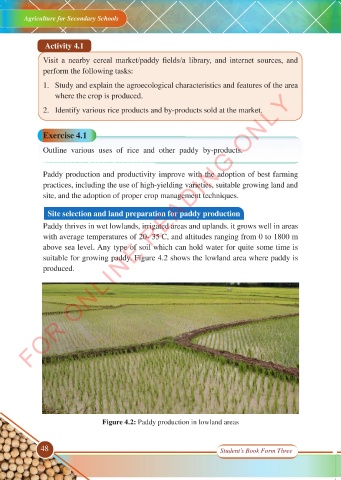
              suitable for growing paddy. Figure 4.2 shows the lowland area where paddy is
              produced.


                                Figure 4.2: Paddy production in lowland areas


             48                                                     Student’s Book Form Three


                                                                                            17/09/2025   14:11
     AGRICULTURE F3.indd   48
     AGRICULTURE F3.indd   48                                                               17/09/2025   14:11

