


Page 58 - Agriculture_Form_3
P. 58
Agriculture for Secondary Schools


              Land preparation for paddy fields is an important step that directly affects crop
              establishment and yield. Two main practices distinguish paddy land preparation
              from other crops. These are bund making and puddling. The process begins with
              land clearance, followed by thorough ploughing to loosen the soil and incorporate
              organic matter. It is then harrowed to break down soil clods and achieve a smooth
          FOR ONLINE READING ONLY
              and even surface. Strong field bunds are constructed around the plot to retain
              water, while drainage channels may be added for efficient water management.
              This is followed by levelling to ensure uniform water distribution. The field is
              then puddled or flooded with water and tilled to create a soft, muddy layer that
              minimises water loss through percolation and provides a suitable environment
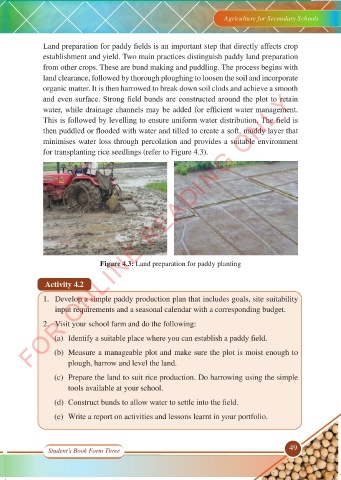
              for transplanting rice seedlings (refer to Figure 4.3).


                               Figure 4.3: Land preparation for paddy planting


               Activity 4.2
              1.  Develop a simple paddy production plan that includes goals, site suitability
                  input requirements and a seasonal calendar with a corresponding budget.

              2.  Visit your school farm and do the following:

                 (a)  Identify a suitable place where you can establish a paddy field.

                 (b)  Measure a manageable plot and make sure the plot is moist enough to
                      plough, harrow and level the land.
                 (c)  Prepare the land to suit rice production. Do harrowing using the simple
                      tools available at your school.

                 (d)  Construct bunds to allow water to settle into the field.

                 (e)  Write a report on activities and lessons learnt in your portfolio.


                Student’s Book Form Three                                                49


                                                                                            17/09/2025   14:11
     AGRICULTURE F3.indd   49                                                               17/09/2025   14:11
     AGRICULTURE F3.indd   49

