


Page 59 - Agriculture_Form_3
P. 59
Agriculture for Secondary Schools


               Selection of paddy seed variety and planting
              The Selection preference for a certain paddy seed variety is driven by several
              characteristic  features,  including  high yield,  early  maturity, pleasant  aroma
              (fragrant  rice), resistance  to diseases and harsh conditions (saline  soil and
              drought), easy milling and percentage yield of unbroken rice grains. Generally,
          FOR ONLINE READING ONLY
              the  rice  variety  used by most farmers  in  Tanzania  falls  into  two categories:
              traditional and improved rice varieties.

              Traditional rice varieties: These are varieties that are well adapted to natural
              farming environments and have been cultivated for a long time. Examples include
              Mbawambili, Supa, Kalamata  and Kisegese.  They are characterised  by high
              aroma and palatability; however, most take a long time to mature and have lower
              yields. Traditional varieties are identified by their local names in areas where
              they are grown. Thus, similar varieties may have different names in different
              locations.
              Improved rice seed varieties: These are seed varieties that have been scientifically
              developed through breeding to meet specific required characteristics, such as high
              yield, resistance to pests and diseases, tolerance to harsh weather conditions, and
              improved grain quality. There are several improved certified paddy seed varieties
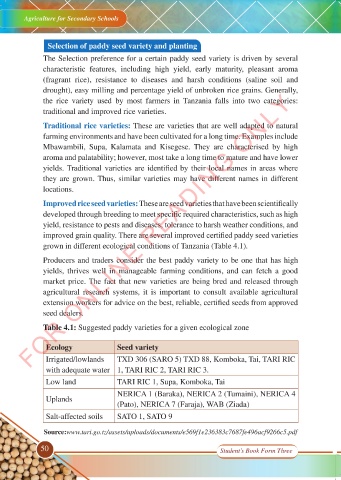
              grown in different ecological conditions of Tanzania (Table 4.1).

              Producers and traders consider the best paddy variety to be one that has high
              yields, thrives well in manageable  farming conditions,  and can fetch a good
              market price. The fact that new varieties are being bred and released through
              agricultural  research systems, it is important  to consult available  agricultural
              extension workers for advice on the best, reliable, certified seeds from approved
              seed dealers.

              Table 4.1: Suggested paddy varieties for a given ecological zone

               Ecology              Seed variety

               Irrigated/lowlands   TXD 306 (SARO 5) TXD 88, Komboka, Tai, TARI RIC
               with adequate water 1, TARI RIC 2, TARI RIC 3.
               Low land             TARI RIC 1, Supa, Komboka, Tai
                                    NERICA 1 (Baraka), NERICA 2 (Tumaini), NERICA 4
               Uplands
                                    (Pato), NERICA 7 (Faraja), WAB (Ziada)

               Salt-affected soils  SATO 1, SATO 9

              Source:www.tari.go.tz/assets/uploads/documents/e569f1e236383c7687fe496acf9266c5.pdf

             50                                                     Student’s Book Form Three


                                                                                            17/09/2025   14:11
     AGRICULTURE F3.indd   50
     AGRICULTURE F3.indd   50                                                               17/09/2025   14:11

