


Page 66 - Agriculture_Form_3
P. 66
Agriculture for Secondary Schools


              the plants. The pest can be controlled by planting pest-resistant varieties and
              applying chemical insecticides. Figure 4.7 shows a green leafhopper on a paddy
              plant.


          FOR ONLINE READING ONLY


                               Figure 4.7: Green leafhopper of the paddy plant
                                               Source: IRRI

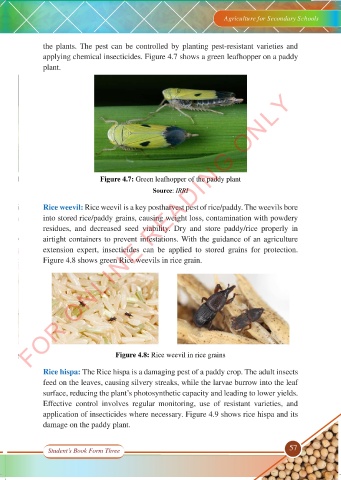
              Rice weevil: Rice weevil is a key postharvest pest of rice/paddy. The weevils bore
              into stored rice/paddy grains, causing weight loss, contamination with powdery
              residues, and decreased  seed viability. Dry and store paddy/rice  properly in
              airtight containers to prevent infestations. With the guidance of an agriculture
              extension  expert, insecticides can be applied  to stored grains for protection.
              Figure 4.8 shows green Rice weevils in rice grain.


                                    Figure 4.8: Rice weevil in rice grains

              Rice hispa: The Rice hispa is a damaging pest of a paddy crop. The adult insects
              feed on the leaves, causing silvery streaks, while the larvae burrow into the leaf
              surface, reducing the plant’s photosynthetic capacity and leading to lower yields.
              Effective  control  involves  regular  monitoring,  use  of  resistant  varieties,  and
              application of insecticides where necessary. Figure 4.9 shows rice hispa and its
              damage on the paddy plant.


                Student’s Book Form Three                                                57


                                                                                            17/09/2025   14:11
     AGRICULTURE F3.indd   57                                                               17/09/2025   14:11
     AGRICULTURE F3.indd   57

