


Page 68 - Agriculture_Form_3
P. 68
Agriculture for Secondary Schools


              management includes using disease-free seeds, planting resistant rice varieties,
              and avoiding excessive nitrogen fertilisation,  which can make plants more
              susceptible to infection. Proper field sanitation and crop rotation also help reduce
              disease incidence. Figure 4.11 shows Bacterial leaf blight disease in paddy plants.
          FOR ONLINE READING ONLY


                            Figure 4.11: Bacterial leaf blight disease in paddy plants

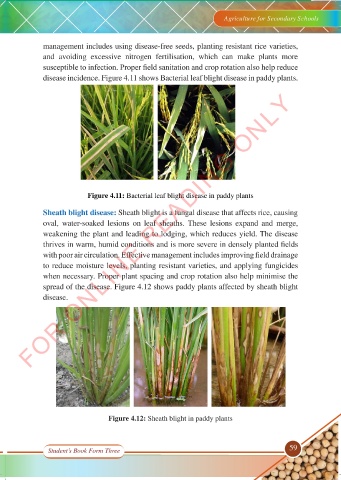
              Sheath blight disease: Sheath blight is a fungal disease that affects rice, causing
              oval, water-soaked lesions on leaf sheaths. These lesions  expand and merge,
              weakening the plant and leading to lodging, which reduces yield. The disease
              thrives in warm, humid conditions and is more severe in densely planted fields
              with poor air circulation. Effective management includes improving field drainage
              to reduce moisture levels, planting resistant varieties, and applying fungicides
              when necessary. Proper plant spacing and crop rotation also help minimise the
              spread of the disease. Figure 4.12 shows paddy plants affected by sheath blight
              disease.


                                  Figure 4.12: Sheath blight in paddy plants


                Student’s Book Form Three                                                59


                                                                                            17/09/2025   14:11
     AGRICULTURE F3.indd   59                                                               17/09/2025   14:11
     AGRICULTURE F3.indd   59

