


Page 69 - Agriculture_Form_3
P. 69
Agriculture for Secondary Schools


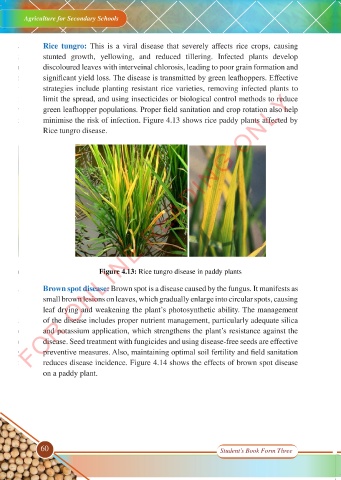
              Rice tungro:  This is a viral  disease that  severely  affects rice  crops, causing
              stunted growth, yellowing, and reduced tillering.  Infected plants develop
              discoloured leaves with interveinal chlorosis, leading to poor grain formation and
              significant yield loss. The disease is transmitted by green leafhoppers. Effective
              strategies include planting resistant rice varieties, removing infected plants to
          FOR ONLINE READING ONLY
              limit the spread, and using insecticides or biological control methods to reduce
              green leafhopper populations. Proper field sanitation and crop rotation also help
              minimise the risk of infection. Figure 4.13 shows rice paddy plants affected by
              Rice tungro disease.


                               Figure 4.13: Rice tungro disease in paddy plants


              Brown spot disease: Brown spot is a disease caused by the fungus. It manifests as
              small brown lesions on leaves, which gradually enlarge into circular spots, causing
              leaf drying and weakening the plant’s photosynthetic ability. The management
              of the disease includes proper nutrient management, particularly adequate silica
              and potassium application, which strengthens the plant’s resistance against the
              disease. Seed treatment with fungicides and using disease-free seeds are effective
              preventive measures. Also, maintaining optimal soil fertility and field sanitation
              reduces disease incidence. Figure 4.14 shows the effects of brown spot disease
              on a paddy plant.


             60                                                     Student’s Book Form Three


                                                                                            17/09/2025   14:11
     AGRICULTURE F3.indd   60                                                               17/09/2025   14:11
     AGRICULTURE F3.indd   60

