


Page 85 - Agriculture_Form_3
P. 85
Agriculture for Secondary Schools


              protect the crop. Good disease management increases yield and bean quality.
              Some of the common diseases are described in the following sub-sections.
              Angular leaf spot: This is a fungal disease which affects leaves. It forms brown,
              square-like spots that reduce leaf health. When severe, the disease causes early
          FOR ONLINE READING ONLY
              leaf  fall  and low yield.  Removing  infected  leaves  helps to minimise  disease
              spread. Practising crop rotation helps to break the disease cycle. Resistant bean
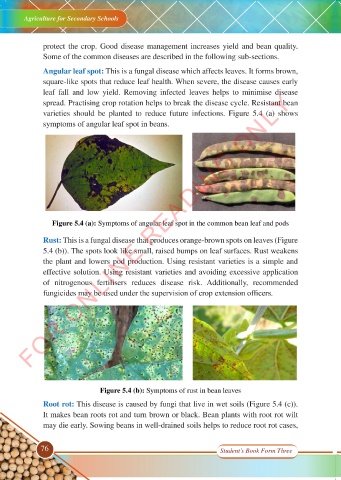
              varieties should be planted to reduce future infections.  Figure 5.4 (a) shows
              symptoms of angular leaf spot in beans.


                 Figure 5.4 (a): Symptoms of angular leaf spot in the common bean leaf and pods

              Rust: This is a fungal disease that produces orange-brown spots on leaves (Figure
              5.4 (b)). The spots look like small, raised bumps on leaf surfaces. Rust weakens
              the plant and lowers pod production. Using resistant varieties is a simple and
              effective solution. Using resistant varieties and avoiding excessive application
              of nitrogenous fertilisers  reduces  disease  risk.  Additionally, recommended
              fungicides may be used under the supervision of crop extension officers.


                               Figure 5.4 (b): Symptoms of rust in bean leaves
              Root rot: This disease is caused by fungi that live in wet soils (Figure 5.4 (c)).
              It makes bean roots rot and turn brown or black. Bean plants with root rot wilt
              may die early. Sowing beans in well-drained soils helps to reduce root rot cases,


             76                                                     Student’s Book Form Three


                                                                                            17/09/2025   14:11
     AGRICULTURE F3.indd   76                                                               17/09/2025   14:11
     AGRICULTURE F3.indd   76

