


Page 288 - Computer_Science_F5
P. 288
Program Example 4.30:

                 A program to interchange value entered by the user

                                 #include<iostream>                                                Chapter Four: Object oriented programming with C++
                                 using namespace std;
          FOR ONLINE READING ONLY
                                 void increment(int &m)
                                 {
                                        m++;
                                        cout<<”The address of m is “<<&m<<endl;
                                        cout<<”m inside the function is “<<m<<endl;
                                 }
                                 int main()
                                 {
                                        int x = 1;
                                        cout<<”The address of x is “<<&x<<endl;
                                        cout<<”Before the call, x is “<<x<<endl;
                                        increment(x); //call by reference
                                        cout<<”After the call, x is “<<x<<endl;
                                        return 0;
                                 }
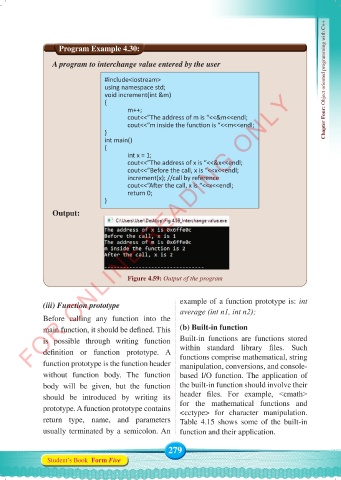
                 Output:


                                        Figure 4.59: Output of the program


              (iii) Function prototype                 example of a function prototype is: int
                                                       average (int n1, int n2);
              Before  calling  any  function  into  the
              main function, it should be defined. This   (b) Built-in function
              is  possible  through  writing  function   Built-in  functions are functions stored

              definition  or  function  prototype.  A   within  standard  library  files.  Such
                                                       functions comprise mathematical, string
              function prototype is the function header   manipulation, conversions, and console-
              without function body.  The function  based  I/O function. The  application  of
              body will be given, but the function  the built-in function should involve their
              should  be  introduced  by  writing  its   header  files.  For  example,  <cmath>
              prototype. A function prototype contains   for the mathematical  functions  and
                                                       <cctype>  for character  manipulation.
              return  type,  name,  and  parameters    Table 4.15 shows some of the built-in
              usually terminated by a semicolon. An  function and their application.


                                                    279
               Student’s Book  Form Five


     Computer Science Form 5.indd   279                                                     23/07/2024   12:34

