


Page 387 - Computer_Science_F5
P. 387
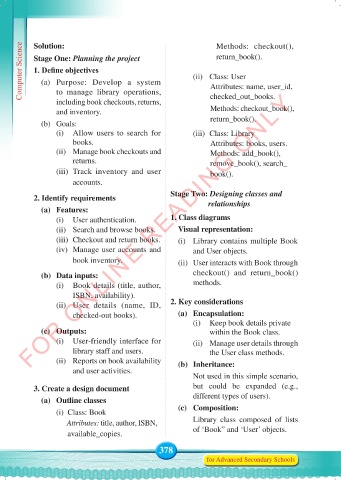
Methods: checkout(),
       Computer Science  Solution:                         (ii)  Class: User
                                                                  return_book().
           Stage One: Planning the project
           1. Define objectives
             (a)  Purpose: Develop a system
                                                                 Attributes: name, user_id,
          FOR ONLINE READING ONLY
                  to manage library operations,
                  including book checkouts, returns,             checked_out_books.
                  and inventory.                                 Methods: checkout_book(),
             (b)  Goals:                                         return_book().
                  (i)  Allow users to search for           (iii)  Class: Library
                       books.                                    Attributes: books, users.
                  (ii)  Manage book checkouts and                Methods: add_book(),
                       returns.                                  remove_book(), search_
                  (iii)  Track inventory and user                book().
                       accounts.

                                                     Stage Two: Designing classes and
           2. Identify requirements                                relationships
             (a)  Features:
                  (i)  User authentication.          1. Class diagrams
                  (ii)  Search and browse books.       Visual representation:
                  (iii)  Checkout and return books.    (i)  Library contains multiple Book
                  (iv)  Manage user accounts and           and User objects.
                       book inventory.                 (ii)  User interacts with Book through

             (b)  Data inputs:                             checkout() and return_book()
                  (i)  Book details (title, author,        methods.
                       ISBN, availability).
                  (ii)  User  details  (name,  ID,   2. Key considerations
                       checked-out books).             (a)  Encapsulation:
                                                           (i)  Keep book details private
             (c)  Outputs:                                      within the Book class.
                  (i)  User-friendly interface for         (ii)  Manage user details through
                       library staff and users.                 the User class methods.
                  (ii)  Reports on book availability   (b)  Inheritance:
                       and user activities.
                                                           Not used in this simple scenario,
           3. Create a design document                     but  could  be  expanded  (e.g.,

             (a)  Outline classes                          different types of users).
                  (i)  Class: Book                     (c)  Composition:
                      Attributes: title, author, ISBN,     Library  class composed  of lists
                      available_copies.                    of ‘Book” and ‘User’ objects.

                                                 378
                                                                for Advanced Secondary Schools


     Computer Science Form 5.indd   378                                                     23/07/2024   12:34

