


Page 125 - Biology_Form_3
P. 125
Biology for Secondary Schools


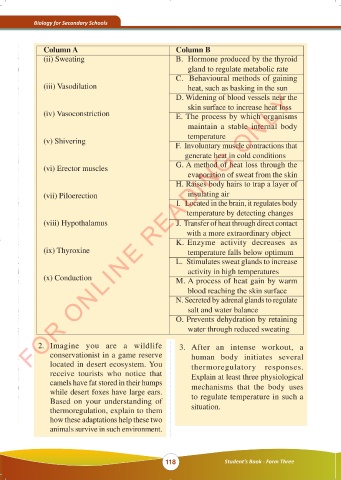
              Column A                                Column B
              (ii) Sweating                           B.  Hormone produced by the thyroid
                                                          gland to regulate metabolic rate
                                                      C.  Behavioural methods of gaining
              (iii) Vasodilation                          heat, such as basking in the sun
          FOR ONLINE READING ONLY
                                                      D. Widening of blood vessels near the
                                                          skin surface to increase heat loss
              (iv) Vasoconstriction                   E. The process by which organisms

                                                          maintain a stable internal body
                                                          temperature
              (v) Shivering
                                                      F.  Involuntary muscle contractions that
                                                         generate heat in cold conditions

              (vi) Erector muscles                    G. A method of heat loss through the
                                                          evaporation of sweat from the skin
                                                      H. Raises body hairs to trap a layer of
              (vii) Piloerection                          insulating air
                                                      I.   Located in the brain, it regulates body
                                                          temperature by detecting changes
              (viii) Hypothalamus                     J.  Transfer of heat through direct contact
                                                          with a more extraordinary object
                                                      K.  Enzyme activity decreases as
              (ix) Thyroxine                              temperature falls below optimum
                                                      L. Stimulates sweat glands to increase
                                                          activity in high temperatures
              (x) Conduction                          M. A process of heat gain by warm
                                                          blood reaching the skin surface
                                                      N. Secreted by adrenal glands to regulate
                                                          salt and water balance
                                                      O. Prevents dehydration by retaining
                                                          water through reduced sweating

             2.  Imagine you are a wildlife            3.  After  an intense  workout,  a
                conservationist in a game reserve          human body initiates several
                located in desert ecosystem. You           thermoregulatory responses.
                receive tourists who notice that           Explain at least three physiological
                camels have fat stored in their humps      mechanisms  that  the  body  uses
                while desert foxes have large ears.        to regulate temperature in such a
                Based  on  your  understanding of
                thermoregulation, explain to them          situation.
                how these adaptations help these two
                animals survive in such environment.


                                                   118               Student’s Book - Form Three


     BIOLOGY FORM 3 FINAL EDITED 16.09.2025.indd   118                                    23/10/2025   11:52:48                     KAMISHNA
                                                                                          23/10/2025   11:52:48
     BIOLOGY FORM 3 FINAL EDITED 16.09.2025.indd   118


                                KAMISHNA

