


Page 29 - Biology_Form_3
P. 29
Coordination in animals


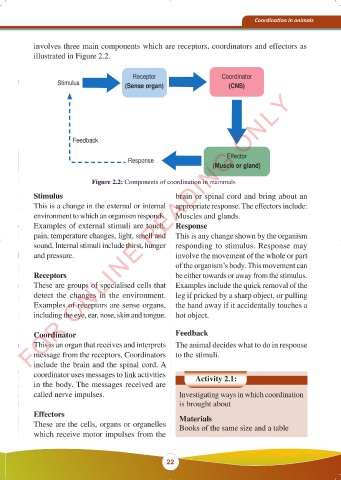
           involves three main components which are receptors, coordinators and effectors as
           illustrated in Figure 2.2.


                                         Receptor                   Coordinator
                  Stimulus             (Sense organ)                  (CNS)
          FOR ONLINE READING ONLY


                       Feedback

                                                                      Effector
                                        Response
                                                                 (Muscle or gland)

                             Figure 2.2: Components of coordination in mammals
           Stimulus                                   brain or spinal cord and bring about an
           This is a change in the external or internal     appropriate response. The effectors include:
           environment to which an organism responds.   Muscles and glands.
           Examples of external stimuli are touch,    Response
           pain, temperature changes, light, smell and   This is any change shown by the organism
           sound. Internal stimuli include thirst, hunger   responding to stimulus. Response may
           and pressure.                              involve the movement of the whole or part
                                                      of the organism’s body. This movement can
           Receptors                                  be either towards or away from the stimulus.
           These are groups of specialised cells that   Examples include the quick removal of the
           detect the changes in the environment.     leg if pricked by a sharp object, or pulling
           Examples of receptors are sense organs,    the hand away if it accidentally touches a
           including the eye, ear, nose, skin and tongue.  hot object.


           Coordinator                                Feedback
           This is an organ that receives and interprets   The animal decides what to do in response
           message from the receptors. Coordinators   to the stimuli.
           include the brain and the spinal cord. A
           coordinator uses messages to link activities     Activity 2.1:
           in the body. The messages received are
           called nerve impulses.                      Investigating ways in which coordination
                                                       is brought about
           Effectors                                   Materials
           These are the cells, organs or organelles   Books of the same size and a table
           which receive motor impulses from the


                                                   22


                                                                                          23/10/2025   11:52:32
     BIOLOGY FORM 3 FINAL EDITED 16.09.2025.indd   22 KAMISHNA                            23/10/2025   11:52:32
     BIOLOGY FORM 3 FINAL EDITED 16.09.2025.indd   22


 KAMISHNA

