


Page 121 - Mathematics_Form_3
P. 121
Circles


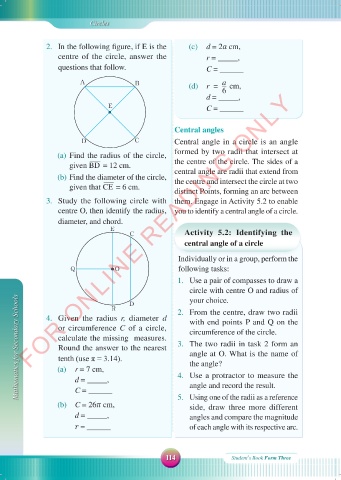
               2.  In the following figure, if E is the   (c)   d = 2   cm,
                   centre of the circle, answer the            r = _____,
                   questions that follow.                      C = ______

                         A                B               ( d )      r  =            cm,
                                                                    a __
          FOR ONLINE READING ONLY
                                                                    6
                                                               d = _____,
                                  E                            C = ______


                                                      Central angles
                          D               C           Central angle in a circle is an angle
                  (a) Find the radius of the circle,   formed by two radii that intersect at
                      given    ‾ BD   = 12 cm.        the centre of the circle. The sides of a
                  (b) Find the diameter of the circle,   central angle are radii that extend from
                                                      the centre and intersect the circle at two
                      given that    ‾ CE   = 6 cm.    distinct Points, forming an arc between
               3.  Study the following circle with  them. Engage in Activity 5.2 to enable
                   centre O, then identify the radius,  you to identify a central angle of a circle.
                   diameter, and chord.
                                  E
                                        C                Activity  5.2:  Identifying  the
                                                         central angle of a circle

                                                       Individually or in a group, perform the
                      Q             O                  following tasks:
                                                       1.  Use a pair of compasses to draw a
                                                          circle with centre O and radius of
      Mathematics for Secondary Schools  (a)   r = 7 cm,             3.  The two radii in task 2 form an
                                                          your choice.
                                        D
                                   R
                                                       2.  From the centre, draw two radii
               4.  Given  the  radius  r,  diameter  d
                                                          with end points P and Q on the
                   or circumference  C of a  circle,
                                                          circumference of the circle.
                   calculate the missing  measures.
                   Round the answer to the nearest
                                                          angle at O. What is the name of
                   tenth (use π = 3.14).
                                                          the angle?
                                                       4.  Use a protractor to measure the
                        d = _____,
                                                          angle and record the result.

                        C = ______
                  (b)   C = 26   cm,                   5.  Using one of the radii as a reference
                                                          side, draw three more different
                        d = _____,                        angles and compare the magnitude

                            = ______                      of each angle with its respective arc.


                                                   114                 Student\s Book Form Three


                                                                                          18/09/2025   09:59:34
     MATHEMATIC F3 SB.indd   114                                                          18/09/2025   09:59:34
     MATHEMATIC F3 SB.indd   114

