


Page 85 - Biology Form Two
P. 85
Biology for Secondary Schools


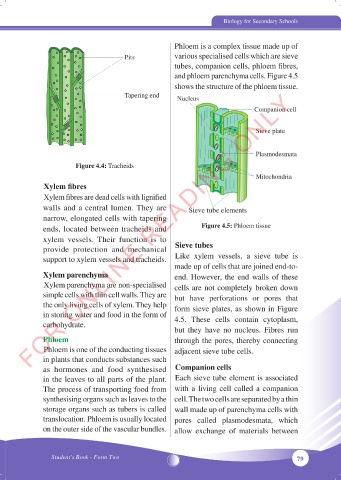
                                                      Phloem is a complex tissue made up of
                                       Pits           various specialised cells which are sieve
                                                      tubes, companion cells, phloem fibres,
                                                      and phloem parenchyma cells. Figure 4.5
                                                      shows the structure of the phloem tissue.
          FOR ONLINE READING ONLY
                                       Tapering end    Nucleus

                                                                              Companion cell


                                                                              Sieve plate


                                                                              Plasmodesmata
                        Figure 4.4: Tracheids
                                                                              Mitochondria
              Xylem fibres
              Xylem fibres are dead cells with lignified
              walls and a central lumen. They are         Sieve tube elements
              narrow, elongated cells with tapering
              ends, located between tracheids and             Figure 4.5: Phloem tissue
              xylem vessels.  Their function is to
              provide  protection and mechanical      Sieve tubes
              support to xylem vessels and tracheids.  Like  xylem  vessels,  a  sieve  tube  is
                                                      made up of cells that are joined end-to-
              Xylem parenchyma                        end. However, the end walls of these
              Xylem parenchyma are non-specialised    cells are not completely broken down
              simple cells with thin cell walls. They are   but  have  perforations  or  pores  that
              the only living cells of xylem. They help   form sieve plates, as shown in Figure
              in storing water and food in the form of   4.5.  These cells contain cytoplasm,
              carbohydrate.
                                                      but they have no nucleus. Fibres run
              Phloem                                  through the pores, thereby connecting
              Phloem is one of the conducting tissues   adjacent sieve tube cells.
              in plants that conducts substances such
              as  hormones and food synthesised       Companion cells
              in the leaves to all parts of the plant.   Each sieve tube element is associated
              The process of transporting food from  with a living cell called a companion
              synthesising organs such as leaves to the  cell. The two cells are separated by a thin
              storage organs such as tubers is called  wall made up of parenchyma cells with
              translocation. Phloem is usually located  pores called  plasmodesmata,  which
              on the outer side of the vascular bundles.   allow exchange of materials between


                 Student’s Book - Form Two                                                 79


                                                                                          05/10/2024   15:36:28
     BIOLOGY FORM 2 NEW.indd   79                                                         05/10/2024   15:36:28
     BIOLOGY FORM 2 NEW.indd   79

