


Page 86 - Chemistry_Form_2
P. 86
Chemistry
                                                                           for Secondary Schools


              A full-headed arrow is used to separate reactants and products for an irreversible
              reaction.
              For example:
                                       Reactants         Products
          FOR ONLINE READING ONLY
              Double half-headed arrows pointing in the opposite directions are used to separate
              reactants and products for a reversible reaction. For example:


                                  Reactants   forward reaction  Products
                                              backward reaction

              The arrows show the direction of a reaction; thus, it means ‘produce’ or ‘yield’.
              Each individual substance is separated from the other by a plus sign (+). Note that
              the number of reactants and products are not necessarily the same. A chemical
              equation has the following key characteristics:
              (a)  Reactants and products: It lists the substances involved in the reaction, with
                   reactants on the left side and products on the right side.
              (b)  Chemical formulas: Each substance is represented using its chemical formula
                   (for example H O for water).
                                 2
              (c)  Direction of reaction: An arrow points from the reactants to the products,
                   indicating the direction of the reaction.

              (d)  Balanced equation: A chemical equation follows the law of conservation of
                   mass, ensuring that the number of atoms for each element is the same on
                   both sides of the equation.

              (e)  States of matter: The physical state of each substance is often indicated.
              (f)  Energy changes: If applicable, energy changes such as heat or light may be
                   noted.
              (g)  Reaction conditions: Temperature, pressure or catalysts may be noted above
                   or below the arrow.

              Molecular equations
              A  molecular  equation  is an equation  representing a  reaction  showing the

              reactants and products in undissociated form. In molecular equations, reactants
              and products are considered neutral regardless of their exact physical states. The
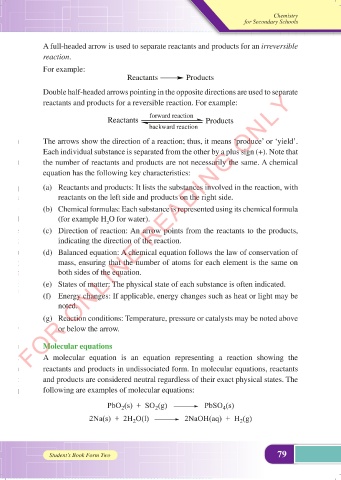
              following are examples of molecular equations:


                Student’s Book Form Two                                              79


                                                                                          01/08/2025   11:20:57
     CHEMISTRY FORM TWO NEW 2025 DUMMY.indd   79                                          01/08/2025   11:20:57
     CHEMISTRY FORM TWO NEW 2025 DUMMY.indd   79

