


Page 129 - Mathematics_Form_Two
P. 129
Logarithms
(h) log 100,000,000 = 8 (o) log x = 7
x
(i) log 1,000 = 3 2 2
x
(j) log 0.0625 = x 4. Determine the number whose
1
2 3 logarithm to base 5 is –3.
(k) log x = 2 5. Solve each of the following:
FOR ONLINE READING ONLY
25
1 (a) log (x + 3 2) = 2
(l) log = − 3
x
27 (b) log 16 = + 5
x
(m) log 256 x= 2 log125 log5−
2
(n) log 1 = x 6. Simplify log 25 log5+ . Mathematics for Secondary Schools
2
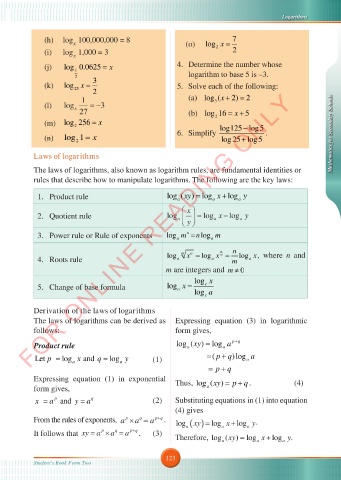
Laws of logarithms
The laws of logarithms, also known as logarithm rules, are fundamental identities or
rules that describe how to manipulate logarithms. The following are the key laws:
1. Product rule log ( ) logxy = a x + log y
a
a
x
2. Quotient rule log a = log x − log y
a
a
y
3. Power rule or Rule of exponents log m = n log m
n
a
a
n
n
n
m
4. Roots rule log a m x = log x = m log x, where n and
a
a
m are integers and m ≠ 0,
log x
c
5. Change of base formula log x = log a
a
c
Derivation of the laws of logarithms
The laws of logarithms can be derived as Expressing equation (3) in logarithmic
follows: form gives,
Product rule log ( ) logxy = a a pq+
a
Let logp = a x and q = log y (1) = ( pq+ )log a
a
a
= pq+
Expressing equation (1) in exponential Thus, log ( )xy = p q+ . (4)
form gives, a
x = a p and y a= q (2) Substituting equations in (1) into equation
(4) gives
From the rules of exponents, a p a = q a pq+ . log ( ) logxy = x + log y .
a
a
It follows that xy a= p a = q a pq+ . (3) Therefore, log ( ) logxy = a a x + log y .
a
a
123
Student's Book Form Two
11/10/2024 20:12:53
MATHEMATIC F2 v5.indd 123
MATHEMATIC F2 v5.indd 123 11/10/2024 20:12:53

