


Page 26 - Mathematics_Form_Two
P. 26
Congruence


           Postulate                                  3.  State the argument which needs to be
           A postulate is a statement that is accepted   proved.
           as true without any proof. These statements   4.  Where  necessary,  make  additional
           are universally accepted, self-evident and    constructions  with dotted lines to
           can form the basis for further reasoning      make the proof clear.
           and making arguments. The following are    5.  In writing the proof;
          FOR ONLINE READING ONLY
           examples of postulates.                       (i)  Refer  the  figures  you  have
     Mathematics for Secondary Schools  (ii)  A straight line can be drawn from   (ii)  Provide arguments with reasons
           (i)  A circle can be drawn with any
                                                              planned to use in the proof.
                centre and radius.
                                                              based on the given information or
                any point to any other point.
                                                              established facts.
           (iii)  All right angles are equal to each
                                                         (iii) Start  with statements  whose
                other.
                                                              validity are given or are obvious.
           Theorem
                                                              conclusion  about  what was
           A theorem is an argument that has been        (iv)  The  final  statement  is  the
                                                              supposed to be proved.
           proved to be true based on past established
           results,  definitions  or  postulates.  The   Engage  in Activity  2.2 to explore more
           following are examples of theorems.        about postulates, proofs, and theorems.
           (i)  The  sum of interior  angles  of a     Activity 2�2: Exploring postulates,
                triangle is 180 degrees.                            proofs, and theorems
           (ii)  In a right-angled triangle, the square   Identify a list of postulates, proofs, and
                of the  length of the  hypotenuse is   theorems  from reliable  sources and
                equal to the sum of the squares of the   briefly explain why each is accepted as
                lengths of the other two sides.        a postulate, proof or theorem.
           (iii) The  sum of interior  angles  of a
                quadrilateral is 360 degrees.
                                                       Example 2�1
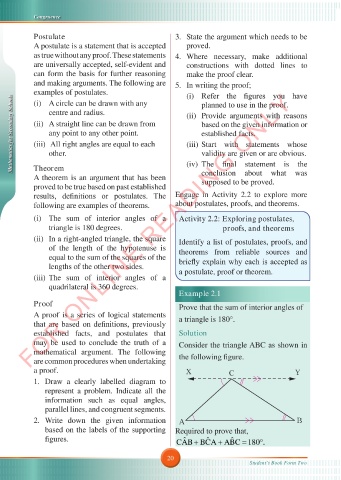
           Proof                                       Prove that the sum of interior angles of
           A proof is a series of logical statements   a triangle is 180°.
           that are based on definitions, previously
           established facts, and postulates that      Solution
           may  be used to  conclude  the  truth  of a   Consider the triangle ABC as shown in
           mathematical  argument.  The following
           are common procedures when undertaking      the following figure.
           a proof.
           1.  Draw a clearly labelled  diagram to
               represent  a problem.  Indicate  all  the
               information  such as equal  angles,
               parallel lines, and congruent segments.
           2.  Write down the given information
               based on the labels of the supporting  Required to prove that,
               figures.                               CAB BCA ABC 180 .+  ˆ  ˆ  +  ˆ  =  °


                                                    20
                                                                            Student's Book Form Two


                                                                                          11/10/2024   20:11:12
     MATHEMATIC F2 v5.indd   20
     MATHEMATIC F2 v5.indd   20                                                           11/10/2024   20:11:12

