Page 35 - Mathematics_Form_Two
P. 35

Congruence


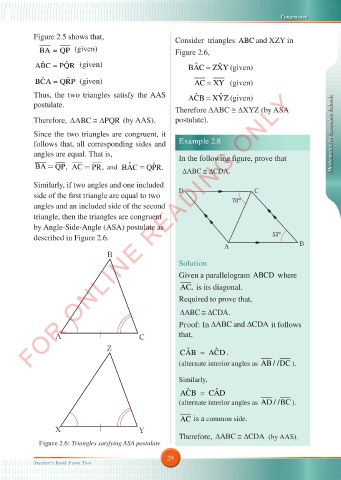
           Figure 2.5 shows that,                     Consider  triangles  ABC and XZY in

               BA = QP    (given)                     Figure 2.6,
                     ˆ
              ˆ
            ABC = PQR (given)                                BAC =  ZXY (given)
                                                            ˆ
                                                                   ˆ

                     ˆ
              ˆ
            BCA = QRP (given)                                   AC = XY   (given)

          FOR ONLINE READING ONLY
           Thus, the two triangles  satisfy the AAS          ACB XYZ (given)
                                                                   ˆ
                                                            ˆ
                                                               =
           postulate.
                                                      Therefore ∆ABC ≅ ∆XYZ (by ASA
           Therefore,  ABC    PQR (by AAS).        postulate).
           Since the two triangles are congruent, it                                                 Mathematics for Secondary Schools
           follows that, all corresponding sides and   Example 2�8
           angles are equal. That is,                  In the following figure, prove that
                                        ˆ
                                               ˆ
            BA = QP,  AC = PR, and  BAC = QPR.
                                                         ABC   CDA.
           Similarly, if two angles and one included
           side of the first triangle are equal to two
           angles and an included side of the second
           triangle, then the triangles are congruent
           by Angle-Side-Angle (ASA) postulate as
           described in Figure 2.6.


                                                       Solution
                                                       Given a parallelogram ABCD  where
                                                        AC,  is its diagonal.
                                                       Required to prove that,

                                                        ABC   CDA.
                                                       Proof: In  ABC and CDA     it follows
                                                       that,

                                                                  ˆ
                                                          ˆ
                                                       CAB  =   ACD .
                                                       (alternate interior angles as AB / /DC ).

                                                       Similarly,
                                                          ˆ
                                                                  ˆ
                                                        ACB  =   CAD
                                                       (alternate interior angles as AD / /BC ).

                                                        AC AC=  is a common side.


                                                       Therefore,  ABC   CDA  (by AAS).
             Figure 2�6: Triangles satsfying ASA postulate

                                                    29
           Student's Book Form Two


                                                                                          11/10/2024   20:11:20
     MATHEMATIC F2 v5.indd   29                                                           11/10/2024   20:11:20
     MATHEMATIC F2 v5.indd   29
   30   31   32   33   34   35   36   37   38   39   40