


Page 72 - Mathematics_Form_Two
P. 72
Algebra


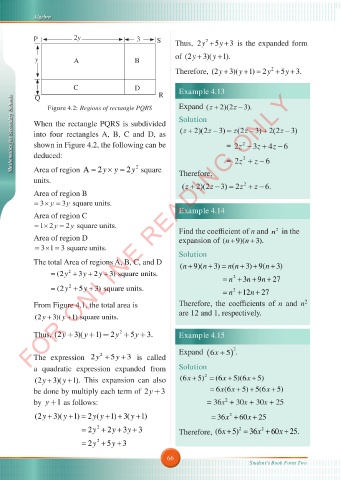
           P           2y                 3      S    Thus,  2y +  2  5y +  3 is the expanded form


            y          A                  B           of (2y +  3)(y +  1).
                                                      Therefore, (2y +  3)(y +  1) 2y=  2  +  5y +  3.


                       C
                                          D
            1  Figure 4�2: Regions of rectangle PQRS  R  Example 4�13    - 3).
          FOR ONLINE READING ONLY
            Q
     Mathematics for Secondary Schools  When the rectangle PQRS is subdivided   Solution  3) =  zz  3z +  3) 2(2z+ 4z −  6 - 3)
                                                       Expand  (z
                                                                    2)(2z +
                                                                         (2 -
                                                       (z +
                                                            2)(2z -
           into  four rectangles A, B, C and  D, as
           shown in Figure 4.2, the following can be
                                                                          2
                                                                               =  2z −
           deduced:
                                                                              z
                                                                          2
                                                                                 6
           Area of region  A =
                                          2
                                                       Therefore,
           units.              2y y× =  2y square                              =  2z +− 6.
                                                                           2
                                                                  -
                                                                    3)
                                                                        2z=
                                                        (z
                                                           +
                                                            2)(2z
                                                                              z + -
           Area of region B
         B3 y= ´    3y =  square units.
           Area of region C                            Example 4�14
         C 12y= ´    2y =  square units.               Find the coefficient of n and  n in the
                                                                                    2
           Area of region D                            expansion of (n +  9 )(n +  3 ).
         D = 31 3´ =  square units.
                                                       Solution
           The total Area of regions A, B, C, and D    (n +  9 )(n +  ) 3 =  ( nn +  ) 3 +  ( 9 n +  ) 3
                =  (2y +  2  3y +  2y +  3) square units .
                                                                    = n 2  3n + +  9n +  27
                =  (2y +  2  5y +  3)  square units.                = n + 12n +  7 2
                                                                        2
           From Figure 4.1, the total area is          Therefore,  the  coefficients  of  n and  n 2
            (2y +  3)(y +  1)  square units.           are 12 and 1, respectively.
           Thus, (2y+3)(y+1) = 2y +5y+3.               Example 4�15
                                     2
                                                                        2
                                                       Expand  (6x +   ) 5 .
           The expression  2y +  2  5y +  3  is called
           a quadratic expression expanded from        Solution
            (2y +  3)(y +  1). .  This expansion can also   (6x +  5) =  2  (6x +  5)(6x +  5)
           be done by multiply each term of  2y+3                =  6 (6xx +  5) 5(6x+  +  5)
                                                                     2
           by  y+1 as follows:                                  = 36x  + 30x + 30x + 25
                          =
                                  1) 3(y +
            (2y + 3)(y + 1) 2 ( y y ++      1)                         =  36x +  2  60x +  25
                          =  2y +  2  2y +  3y +  3    Therefore, (6x +  5) =  2  36x +  2  60x +  25.
                          =  2y +  2  5y +  3

                                                    66
                                                                            Student's Book Form Two


                                                                                          11/10/2024   20:11:52
     MATHEMATIC F2 v5.indd   66                                                           11/10/2024   20:11:52
     MATHEMATIC F2 v5.indd   66

