


Page 73 - Physics_Form_2
P. 73
Current electricity
3. Close switch S and adjust the rheostat, R , to give appropriate current, I, and
h
voltage, V.
4. Record the initial temperature θ of water and leave the circuit ON for a time, t,
1
which is monitored by a stopwatch.
5. After time, t, record the final temperature θ . The change in temperature will be
2
FOR ONLINE READING ONLY
θ = θ −θ .
2 1
6. Adjust R to obtain different values of I and V and repeat steps 4 and 5, to obtain
h
at least two or more sets of I, V and θ.
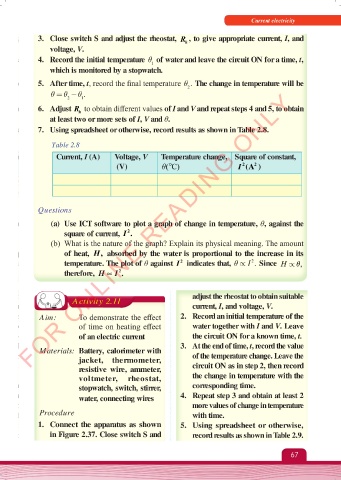
7. Using spreadsheet or otherwise, record results as shown in Table 2.8.
Table 2.8
Current, I (A) Voltage, V Temperature change, Square of constant,
(V) θ(°C) I 2 (A )
2
Questions
(a) Use ICT software to plot a graph of change in temperature, θ, against the
square of current, I 2 .
(b) What is the nature of the graph? Explain its physical meaning. The amount
,
of heat, H absorbed by the water is proportional to the increase in its
2
temperature. The plot of θ against I indicates that, θ ∝ I . Since H ∝ θ,
2
therefore, H I 2 .
adjust the rheostat to obtain suitable
Activity 2.11
current, I, and voltage, V.
Aim: To demonstrate the effect 2. Record an initial temperature of the
of time on heating effect water together with I and V. Leave
of an electric current the circuit ON for a known time, t.
3. At the end of time, t, record the value
Materials: Battery, calorimeter with of the temperature change. Leave the
jacket, thermometer,
resistive wire, ammeter, circuit ON as in step 2, then record
voltmeter, rheostat, the change in temperature with the
stopwatch, switch, stirrer, corresponding time.
water, connecting wires 4. Repeat step 3 and obtain at least 2
more values of change in temperature
Procedure with time.
1. Connect the apparatus as shown 5. Using spreadsheet or otherwise,
in Figure 2.37. Close switch S and record results as shown in Table 2.9.
67
Physics Form 2 Final.indd 67 25/10/2025 10:26

