


Page 265 - Computer_Science_F5
P. 265
Computer Science  Operator precedence in C++
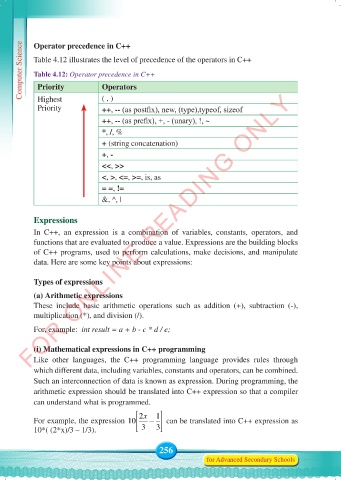
           Table 4.12 illustrates the level of precedence of the operators in C++

           Table 4.12: Operator precedence in C++
                                Operators
            Priority
          FOR ONLINE READING ONLY
            Highest
            Priority            ( , )
                                ++, -- (as postfix), new, (type),typeof, sizeof
                                ++, -- (as prefix), +, - (unary), !, ~
                                *, /, %
                                + (string concatenation)
                                +, -
                                <<, >>
                                <, >, <=, >=, is, as
                                = =, !=

                                &, ^, |

           Expressions

           In C++, an expression is a combination  of variables, constants, operators, and
           functions that are evaluated to produce a value. Expressions are the building blocks
           of C++ programs, used to perform calculations, make decisions, and manipulate
           data. Here are some key points about expressions:


           Types of expressions

           (a) Arithmetic expressions
           These  include  basic  arithmetic  operations  such as addition  (+), subtraction  (-),
           multiplication (*), and division (/).
           For, example:  int result = a + b - c * d / e;


           (i) Mathematical expressions in C++ programming
           Like  other  languages,  the  C++  programming  language  provides  rules  through
           which different data, including variables, constants and operators, can be combined.
           Such an interconnection of data is known as expression. During programming, the
           arithmetic expression should be translated into C++ expression so that a compiler
           can understand what is programmed.
                                          ⎡ 2x  1 ⎤
           For example, the expression 10 ⎢   − ⎥  can be translated into C++ expression as
           10*( (2*x)/3 – 1/3).           ⎢ ⎣  3  3 ⎥ ⎦


                                                 256
                                                                for Advanced Secondary Schools


     Computer Science Form 5.indd   256                                                     23/07/2024   12:33

