


Page 266 - Computer_Science_F5
P. 266
(ii) Operator precedence in mathematical expressions
Levels of precedence between operators, both in arithmetic expression and C++
expressions, remain the same. That level starts from the operation enclosed by
brackets, followed by arithmetic operators out of the brackets. Priority is given to Chapter Four: Object oriented programming with C++
division and multiplication, followed by addition and subtraction. If the expression
FOR ONLINE READING ONLY
includes several arithmetic operators of the same type the operation will be conducted
from left to right.
Activity 4.4:
Writing mathematical expression using C++ programs
Practice on how to write mathematical expressions in C++ programs by following
the steps below:
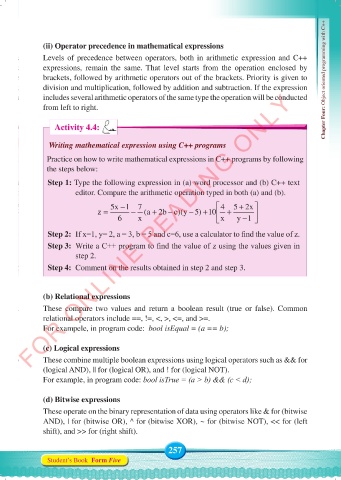
Step 1: Type the following expression in (a) word processor and (b) C++ text
editor. Compare the arithmetic operation typed in both (a) and (b).
5 x 1 7 4 5 x2
z a ( b2 )(c y )5 10
6 x x y 1
Step 2: If x=1, y= 2, a = 3, b = 5 and c=6, use a calculator to find the value of z.
Step 3: Write a C++ program to find the value of z using the values given in
step 2.
Step 4: Comment on the results obtained in step 2 and step 3.
(b) Relational expressions
These compare two values and return a boolean result (true or false). Common
relational operators include ==, !=, <, >, <=, and >=.
For exampele, in program code: bool isEqual = (a == b);
(c) Logical expressions
These combine multiple boolean expressions using logical operators such as && for
(logical AND), || for (logical OR), and ! for (logical NOT).
For example, in program code: bool isTrue = (a > b) && (c < d);
(d) Bitwise expressions
These operate on the binary representation of data using operators like & for (bitwise
AND), | for (bitwise OR), ^ for (bitwise XOR), ~ for (bitwise NOT), << for (left
shift), and >> for (right shift).
257
Student’s Book Form Five
Computer Science Form 5.indd 257 23/07/2024 12:33

