


Page 306 - Computer_Science_F5
P. 306
};
                   // This code shows a child class Rectangle
                   class Rectangle : public Shape {
                   public:                                                                         Chapter Four: Object oriented programming with C++
          FOR ONLINE READING ONLY
                       // Overriding the draw() method
                       void draw() override {
                           cout << “ The drawn rectangle is expected here “ << endl;
                       }
                   };
                   // This function will draw any shape
                   void drawShape(Shape* shape) {
                       shape->draw();
                   }
                   int main() {
                       //This will create objects of various shapes
                       Circle circle;
                       Rectangle rectangle;
                       // This shows behaviors for Polymorphism
                       drawShape(&circle);
                       drawShape(&rectangle);
                       return 0;
                   }


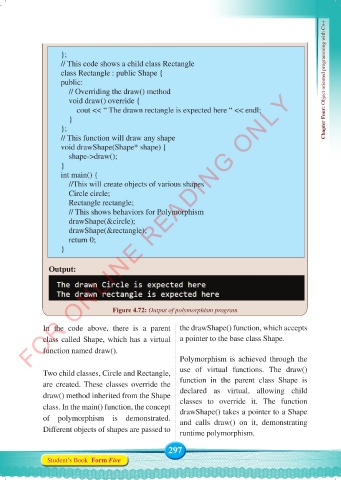
                Output:


                                   Figure 4.72: Output of polymorphism program

              In the  code  above,  there  is  a  parent  the drawShape() function, which accepts
              class called Shape, which has a virtual  a pointer to the base class Shape.
              function named draw().
                                                       Polymorphism is achieved through the

              Two child classes, Circle and Rectangle,   use of virtual  functions.  The  draw()
              are created. These classes override the   function  in  the  parent  class  Shape  is
              draw() method inherited from the Shape   declared  as virtual,  allowing child
                                                       classes to override it.  The function
              class. In the main() function, the concept   drawShape() takes a pointer to a Shape
              of polymorphism  is demonstrated.        and calls  draw() on it, demonstrating
              Different objects of shapes are passed to   runtime polymorphism.


                                                    297
               Student’s Book  Form Five


     Computer Science Form 5.indd   297                                                     23/07/2024   12:34

