


Page 20 - Biology_Form_3
P. 20
Coordination in plants


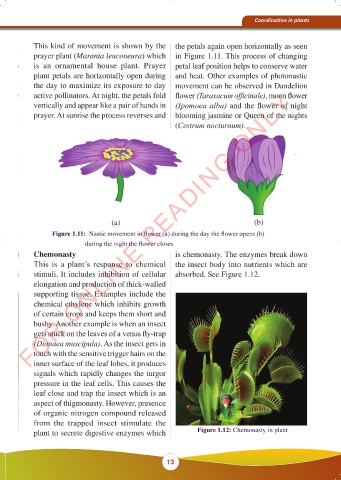
           This kind of movement is shown by the      the petals again open horizontally as seen
           prayer plant (Maranta leuconeura) which    in Figure 1.11. This process of changing
           is an ornamental house plant. Prayer       petal leaf position helps to conserve water
           plant petals are horizontally open during   and heat. Other examples of photonastic
           the day to maximize its exposure to day    movement can be observed in Dandelion
          FOR ONLINE READING ONLY
           active pollinators. At night, the petals fold   flower (Taraxacum officinale), moon flower
           vertically and appear like a pair of hands in   (Ipomoea alba) and the flower of night
           prayer. At sunrise the process reverses and   blooming jasmine or Queen of the nights
                                                      (Cestrum nocturnum).


                                   (a)                                        (b)
                 Figure 1.11:  Nastic movement in flower (a) during the day the flower opens (b)
                                     during the night the flower closes
           Chemonasty                                 is chemonasty. The enzymes break down
           This is a plant’s response to chemical  the insect body into nutrients which are
           stimuli. It includes inhibition of cellular  absorbed. See Figure 1.12.
           elongation and production of thick-walled
           supporting tissue. Examples include the
           chemical ethylene which inhibits growth
           of certain crops and keeps them short and
           bushy. Another example is when an insect
           gets stuck on the leaves of a venus fly-trap
           (Dionaea muscipula). As the insect gets in
           touch with the sensitive trigger hairs on the
           inner surface of the leaf lobes, it produces
           signals which rapidly changes the turgor
           pressure in the leaf cells. This causes the
           leaf close and trap the insect which is an
           aspect of thigmonasty. However, presence
           of organic nitrogen compound released
           from the trapped insect stimulate the
           plant to secrete digestive enzymes which          Figure 1.12: Chemonasty in plant


                                                   13


                                                                                          23/10/2025   11:52:30
     BIOLOGY FORM 3 FINAL EDITED 16.09.2025.indd   13 KAMISHNA                            23/10/2025   11:52:30
     BIOLOGY FORM 3 FINAL EDITED 16.09.2025.indd   13


 KAMISHNA

