


Page 80 - Biology_Form_3
P. 80
Endocrine system


           Gigantism                                  If left untreated, gigantism can cause
           Gigantism is a condition characterised by   severe complications including overgrowth
           excessive growth in children and adolescents   of bones and tissues, and cardiovascular
           due to an overproduction of growth         issues such as increased size of the heart and
           hormones before the closure of growth      blood vessels that result in hypertension,
          FOR ONLINE READING ONLY
           plates in the bones. The most common       heart disease, and even heart failure.
           cause of gigantism is a pituitary tumour   The untreated condition can also lead to
           that secretes excessive Growth Hormone  excessive weight that causes joint damage,
           (GH). The tumour causes an overproduction  leading to arthritis or other bone-related
           of GH leading to an abnormal increase in  issues. The elevated levels of IGF-1 may
           the production of another hormone called  result into insulin resistance may develop,
           insulin-like growth factor 1 (IGF-1), which  increasing the risk of Type 2 diabetes.
           stimulates excessive growth. Other causes  Gigantism typically cannot be prevented,
           may include genetic mutations or certain  especially if caused by genetic factors.
           conditions that affect the pituitary gland.   However, early diagnosis and treatment of
           The most noticeable symptom is an increase  pituitary tumours can help control excessive
           in height due to excessive bone growth,  growth.
           enlargement of hands and feet, and enlarged
           facial features, including the jaw, nose, and  Dwarfism
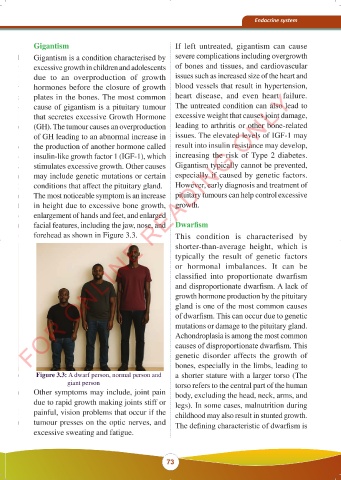
           forehead as shown in Figure 3.3.           This  condition  is  characterised  by

                                                      shorter-than-average height, which is
                                                      typically the result of genetic factors
                                                      or  hormonal  imbalances.  It  can  be
                                                      classified  into  proportionate  dwarfism
                                                      and disproportionate dwarfism. A lack of
                                                      growth hormone production by the pituitary
                                                      gland is one of the most common causes
                                                      of dwarfism. This can occur due to genetic
                                                      mutations or damage to the pituitary gland.
                                                      Achondroplasia is among the most common
                                                      causes of disproportionate dwarfism. This
                                                      genetic disorder affects the growth of
                                                      bones, especially in the limbs, leading to
            Figure 3.3: A dwarf person, normal person and   a shorter stature with a larger torso (The
                     giant person                     torso refers to the central part of the human
           Other symptoms may include, joint pain     body, excluding the head, neck, arms, and
           due to rapid growth making joints stiff or   legs). In some cases, malnutrition during
           painful, vision problems that occur if the   childhood may also result in stunted growth.
           tumour presses on the optic nerves, and    The defining characteristic of dwarfism is
           excessive sweating and fatigue.


                                                   73


                                                                                          23/10/2025   11:52:42
     BIOLOGY FORM 3 FINAL EDITED 16.09.2025.indd   73
     BIOLOGY FORM 3 FINAL EDITED 16.09.2025.indd   73 KAMISHNA                            23/10/2025   11:52:42


 KAMISHNA

