


Page 148 - Mathematics_Form_3
P. 148
Circles


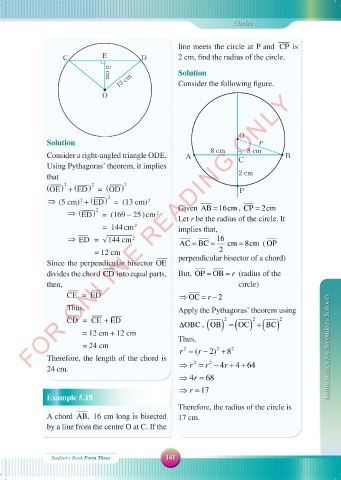
                                                       line meets the circle at P and    ‾  CP    is
                    C           E           D          2 cm, find the radius of the circle.

                                                       Solution
                                     13 cm             Consider the following figure.
                                 5 cm
          FOR ONLINE READING ONLY
                                O


                                                                         O
               Solution                                                        r
                                                                 8 cm       8 cm
               Consider a right-angled triangle ODE.     A                             B
                                                                         C
               Using Pythagoras’ theorem, it implies
                                                                         2 cm
               that
                    2        2         2
                     (  ‾ OE   )      +    (   ‾ ED   )        =     (  ‾ OD   )       P
                                  2
                         2
                                              2
               ⇒   (5 cm)     +    (   ‾ ED   )        =   (13 cm)
                              2                        Given  AB 16cm=   , CP =  2cm

                      ⇒ ( ‾ ED   )        =  (169 − 25 ) c m       Let r be the radius of the circle. It
                                                2
                                  =  144  cm           implies that,
                                          2
                                 _
                      ⇒   ‾  ED    =   √ 144 c m    2       AC =  BC =  16  cm 8cm=  (OP
                                       = 12 cm                     2
               Since the perpendicular bisector    ‾ OE      perpendicular bisector of a chord)
               divides the chord CD into equal parts,   But, OP =  OB r=   (radius of the
               then,                                                     circle)
                          ‾     =    ‾ ED              ⇒  OC =  r −  2
                     CE
                     Thus,                             Apply the Pythagoras’ theorem using
                                                                ( ) ( ) ( )
                       ‾     =    ‾ CE   +   ‾ ED                    2       2        2
                     CD
                                                       ∆ OBC ,  OB    =  OC +    BC
                                 = 12 cm + 12 cm
                                                       Thus,
                             = 24 cm
                                                       r =  2  (r −  2) +  2  8 2                   Mathematics for Secondary Schools
               Therefore, the length of the chord is        2   2
                                                                        4 64
               24 cm.                                  ⇒  r =  r −  4r ++
                                                       ⇒  4r =  68

                                                          r
                                                       ⇒=     17
               Example 5.18
                                                       Therefore, the radius of the circle is
               A chord  AB,  16 cm long is bisected    17 cm.
               by a line from the centre O at C. If the


                 Student\s Book Form Three         141


                                                                                          18/09/2025   09:59:46
     MATHEMATIC F3 SB.indd   141                                                          18/09/2025   09:59:46
     MATHEMATIC F3 SB.indd   141

