


Page 68 - Mathematics_Form_3
P. 68
Linear programming


              while  px qy+  ≥  r  is a constraint for a   Solution
              minimization problem, where p, q and r   The given information is summarized
              are constants.                           in the following table.

              Non-negativity constraints                             Resources
                                                                                    Profit
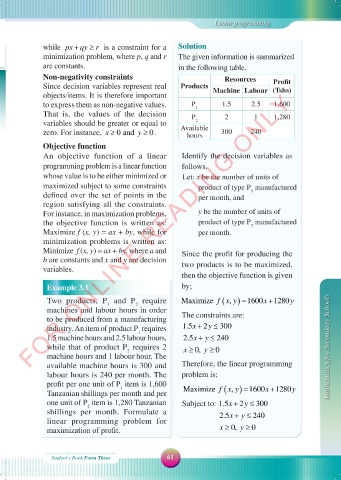
              Since decision variables represent real   Products  Machine Labour   (Tshs)
          FOR ONLINE READING ONLY
              objects/items. It is therefore important
              to express them as non-negative values.      P 1      1.5      2.5    1,600
              That is, the values of the decision          P         2        1     1,280
              variables should be greater or equal to       2
              zero. For instance,  x ≥  0 and y ≥  0 .  Available   300      240
                                                         hours
              Objective function
              An  objective  function of a linear       Identify the decision variables as
              programming problem is a linear function   follows.
              whose value is to be either minimized or   Let: x be the number of units of
              maximized subject to some constraints          product of type P  manufactured
              defined over the set of points in the          per month, and  1
              region satisfying all the constraints.
              For instance, in maximization problems,        y be the number of units of
              the objective function is written as:          product of type P  manufactured
                                                                             2
              Maximize f (x, y) = ax + by, while for         per month.
              minimization problems is written as:
              Minimize  f (x, y) = ax + by, where a and   Since the profit for producing the
              b are constants and x and y are decision   two products is to be maximized,
              variables.
                                                        then the objective function is given
               Example 3.1                              by;

               Two products, P  and P  require          Maximize f  ( ,xy ) 1600x=  + 1280y
                                          2
                                 1
               machines and labour hours in order
               to be produced from a manufacturing      The constraints are:
               industry. An item of product P  requires   1.5x +  2y ≤  300
                                           1
               1.5 machine hours and 2.5 labour hours,   2.5x +≤   240
                                                               y
               while that of product P  requires 2       x ≥  0, y ≥  0                             Mathematics for Secondary Schools
                                       2
               machine hours and 1 labour hour. The
               available machine hours is 300 and       Therefore, the linear programming
               labour hours is 240 per month. The       problem is;
               profit per one unit of P  item is 1,600
                                     1
               Tanzanian shillings per month and per    Maximize f   ( ,xy ) 1600x=  + 1280y
               one unit of P  item is 1,280 Tanzanian   Subject to: 1.5x +  2y ≤  300
                           2
               shillings per month. Formulate a                    2.5x +≤   240
                                                                          y
               linear programming problem for
               maximization of profit.                             x ≥  0, y ≥  0


                 Student\s Book Form Three          61


                                                                                          18/09/2025   09:59:07
     MATHEMATIC F3 SB.indd   61                                                           18/09/2025   09:59:07
     MATHEMATIC F3 SB.indd   61

