


Page 123 - Biology Form Two
P. 123
Biology for Secondary Schools


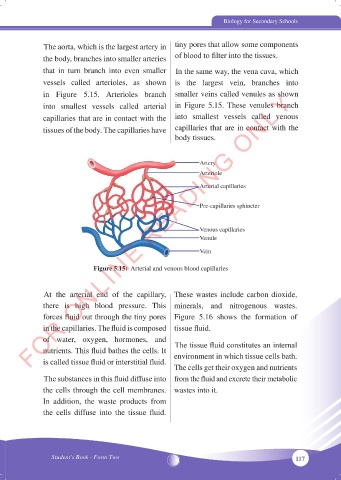
              The aorta, which is the largest artery in   tiny pores that allow some components
              the body, branches into smaller arteries   of blood to filter into the tissues.
              that  in  turn  branch  into  even  smaller  In the same way, the vena cava, which

              vessels called arterioles,  as shown  is the largest vein, branches into
          FOR ONLINE READING ONLY
              in Figure 5.15.  Arterioles branch  smaller veins called venules as shown
              into smallest vessels called  arterial  in Figure 5.15. These  venules branch
              capillaries that are in contact with the   into smallest vessels called venous

              tissues of the body. The capillaries have   capillaries that are in contact with the
                                                      body tissues.


                                                             Artery
                                                             Arteriole
                                                             Arterial capillaries


                                                             Pre-capillaries sphincter


                                                             Venous capillaries
                                                             Venule

                                                             Vein

                             Figure 5.15:  Arterial and venous blood capillaries


              At  the  arterial  end  of  the  capillary,  These wastes include carbon dioxide,
              there  is high blood pressure.  This  minerals,  and nitrogenous wastes.
              forces fluid out through the tiny pores  Figure  5.16 shows the  formation  of
              in the capillaries. The fluid is composed  tissue fluid.
              of water,  oxygen,  hormones, and       The tissue fluid constitutes an internal
              nutrients. This fluid bathes the cells. It   environment in which tissue cells bath.
              is called tissue fluid or interstitial fluid.
                                                      The cells get their oxygen and nutrients
              The substances in this fluid diffuse into  from the fluid and excrete their metabolic

              the cells through the cell membranes.  wastes into it.
              In addition, the waste products from
              the  cells  diffuse  into  the  tissue  fluid.


                 Student’s Book - Form Two                                                117


                                                                                          05/10/2024   15:36:40
     BIOLOGY FORM 2 NEW.indd   117                                                        05/10/2024   15:36:40
     BIOLOGY FORM 2 NEW.indd   117

