


Page 124 - Biology Form Two
P. 124
Biology for Secondary Schools


                                   Capillary Tissue fluid
                                                          Tissue cells
                           Arteriole                                Direction of
                                                                    blood flow


                                                                    Venule
          FOR ONLINE READING ONLY


                        Tissue fluid
                        enters capillary

                                                       Tissue fluid released from capillary
                               Lymphatic vessel

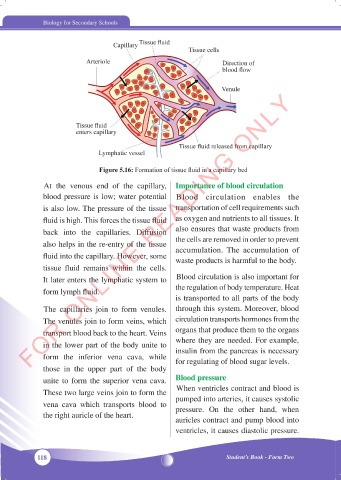
                               Figure 5.16: Formation of tissue fluid in a capillary bed

              At the venous end  of  the  capillary,  Importance of blood circulation
              blood pressure is low; water potential  Blood circulation  enables the
              is also low. The pressure of the tissue  transportation of cell requirements such

              fluid is high. This forces the tissue fluid   as oxygen and nutrients to all tissues. It
              back into the  capillaries. Diffusion   also ensures that waste products from
              also helps in the re-entry of the tissue   the cells are removed in order to prevent
                                                      accumulation.  The  accumulation  of
              fluid into the capillary. However, some   waste products is harmful to the body.

              tissue  fluid  remains  within  the  cells.
              It later enters the lymphatic system to   Blood circulation is also important for
              form lymph fluid.                       the regulation of body temperature. Heat
                                                      is transported to all parts of the body
              The  capillaries join to form venules.  through this system. Moreover, blood

              The venules join to form veins, which   circulation transports hormones from the
              transport blood back to the heart. Veins   organs that produce them to the organs
              in the lower part of the body unite to   where they are needed. For example,
                                                      insulin from the pancreas is necessary
              form  the  inferior  vena  cava,  while   for regulating of blood sugar levels.

              those  in  the  upper  part  of  the  body
              unite to form the superior vena cava.   Blood pressure
              These two large veins join to form the   When ventricles contract and blood is
              vena cava which transports blood to     pumped into arteries, it causes systolic
                                                      pressure.  On the  other  hand,  when
              the right auricle of the heart.
                                                      auricles contract and pump blood into
                                                      ventricles, it causes diastolic pressure.


            118                                                      Student’s Book - Form Two


                                                                                          05/10/2024   15:36:41
     BIOLOGY FORM 2 NEW.indd   118                                                        05/10/2024   15:36:41
     BIOLOGY FORM 2 NEW.indd   118

