


Page 145 - Biology Form Two
P. 145
Biology for Secondary Schools


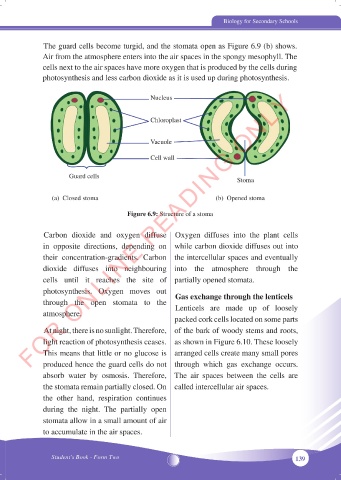
              The guard cells become turgid, and the stomata open as Figure 6.9 (b) shows.
              Air from the atmosphere enters into the air spaces in the spongy mesophyll. The
              cells next to the air spaces have more oxygen that is produced by the cells during
              photosynthesis and less carbon dioxide as it is used up during photosynthesis.
          FOR ONLINE READING ONLY
                                               Nucleus


                                               Chloroplast


                                               Vacuole

                                               Cell wall

                      Guard cells
                                                                         Stoma


                 (a)  Closed stoma                                (b)  Opened stoma

                                        Figure 6.9: Structure of a stoma

              Carbon  dioxide  and  oxygen  diffuse   Oxygen diffuses into the plant cells

              in opposite directions, depending on    while carbon dioxide diffuses out into
              their concentration-gradients. Carbon   the intercellular spaces and eventually
              dioxide  diffuses into  neighbouring    into the atmosphere  through the
              cells  until  it  reaches  the  site  of   partially opened stomata.
              photosynthesis. Oxygen moves out        Gas exchange through the lenticels
              through the open  stomata to the        Lenticels  are made up of loosely
              atmosphere.
                                                      packed cork cells located on some parts
              At night, there is no sunlight. Therefore,   of the bark of woody stems and roots,

              light reaction of photosynthesis ceases.   as shown in Figure 6.10. These loosely
              This means that little or no glucose is   arranged cells create many small pores
              produced hence the guard cells do not   through which gas exchange occurs.
              absorb water by osmosis.  Therefore,    The air spaces between the cells are
              the stomata remain partially closed. On   called intercellular air spaces.
              the other hand, respiration continues
              during  the  night.  The  partially  open
              stomata allow in a small amount of air
              to accumulate in the air spaces.


                 Student’s Book - Form Two                                                139


                                                                                          05/10/2024   15:36:45
     BIOLOGY FORM 2 NEW.indd   139                                                        05/10/2024   15:36:45
     BIOLOGY FORM 2 NEW.indd   139

