


Page 150 - Biology Form Two
P. 150
Biology for Secondary Schools


                                                                         Cork

                       Soda lime                                         Black cloth
                                                                         Bell jar
                   Thistle funnel                                       To filter pump
          FOR ONLINE READING ONLY
                           Cork                                          Cork


                    Lime water                                            Lime water
                    Conical flask                                          Conical flask

                                Potted plant       Polythene paper


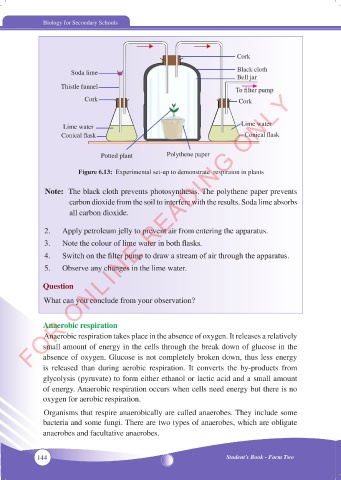
                         Figure 6.13:  Experimental set-up to demonstrate  respiraion in plants

               Note:  The black cloth prevents photosynthesis. The polythene paper prevents
                      carbon dioxide from the soil to interfere with the results. Soda lime absorbs
                      all carbon dioxide.


              2.    Apply petroleum jelly to prevent air from entering the apparatus.
              3.    Note the colour of lime water in both flasks.
              4.    Switch on the filter pump to draw a stream of air through the apparatus.

              5.    Observe any changes in the lime water.

              Question

              What can you conclude from your observation?


              Anaerobic respiration
              Anaerobic respiration takes place in the absence of oxygen. It releases a relatively
              small amount of energy in the cells through the break down of glucose in the
              absence of oxygen. Glucose is not completely broken down, thus less energy
              is released  than during aerobic  respiration.  It converts the by-products from
              glycolysis (pyruvate) to form either ethanol or lactic acid and a small amount
              of energy. Anaerobic respiration occurs when cells need energy but there is no
              oxygen for aerobic respiration.

              Organisms that respire anaerobically are called anaerobes. They include some
              bacteria and some fungi. There are two types of anaerobes, which are obligate
              anaerobes and facultative anaerobes.


            144                                                      Student’s Book - Form Two


                                                                                          05/10/2024   15:36:46
     BIOLOGY FORM 2 NEW.indd   144                                                        05/10/2024   15:36:46
     BIOLOGY FORM 2 NEW.indd   144

