


Page 75 - Biology Form Two
P. 75
Biology for Secondary Schools


              In animal cells, osmosis is important  time,  it  loses a  lot  of water, shrinks,
              for reabsorption of water in the colon  and shrivels. These effects of osmosis
              and kidneys.  This process helps to  on animal cells can be observed in red
              maintain water balance in the body. In  blood cells. Under normal conditions,
          FOR ONLINE READING ONLY
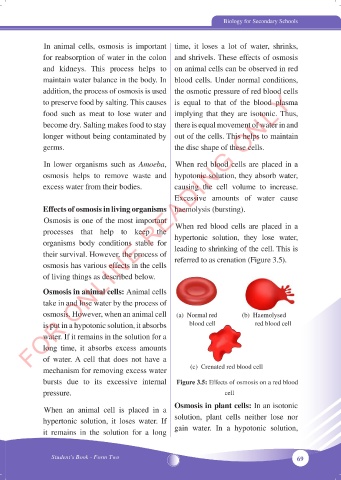
              addition, the process of osmosis is used  the osmotic pressure of red blood cells
              to preserve food by salting. This causes  is equal to  that  of the  blood  plasma
              food such as meat to lose water and  implying that they are isotonic. Thus,

              become dry. Salting makes food to stay  there is equal movement of water in and
              longer without being contaminated by  out of the cells. This helps to maintain
              germs.                                  the disc shape of these cells.

              In lower  organisms such as  Amoeba,  When red blood cells are placed in a
              osmosis helps to remove waste and  hypotonic solution, they absorb water,
              excess water from their bodies.         causing the  cell  volume to increase.
                                                      Excessive amounts of water cause
              Effects of osmosis in living organisms  haemolysis (bursting).

              Osmosis is one of the most important
              processes  that  help  to  keep  the    When red  blood cells are placed in a
              organisms body conditions stable for    hypertonic solution, they lose water,
              their survival. However, the process of   leading to shrinking of the cell. This is
              osmosis has various effects in the cells   referred to as crenation (Figure 3.5).
              of living things as described below.

              Osmosis in animal cells: Animal cells
              take in and lose water by the process of
              osmosis. However, when an animal cell   (a)  Normal red     (b)  Haemolysed
              is put in a hypotonic solution, it absorbs      blood cell      red blood cell

              water. If it remains in the solution for a
              long  time,  it  absorbs excess amounts
              of  water. A  cell  that  does not  have  a
              mechanism for removing excess water          (c)  Crenated red blood cell
              bursts due to its excessive internal    Figure 3.5: Effects of osmosis on a red blood
              pressure.                                              cell

              When an animal  cell  is placed  in a   Osmosis in plant cells: In an isotonic
              hypertonic solution, it loses water. If   solution,  plant  cells  neither  lose  nor

              it  remains in the  solution for a  long   gain water. In a  hypotonic solution,


                 Student’s Book - Form Two                                                 69


                                                                                          05/10/2024   15:36:26
     BIOLOGY FORM 2 NEW.indd   69                                                         05/10/2024   15:36:26
     BIOLOGY FORM 2 NEW.indd   69

