


Page 76 - Biology Form Two
P. 76
Biology for Secondary Schools


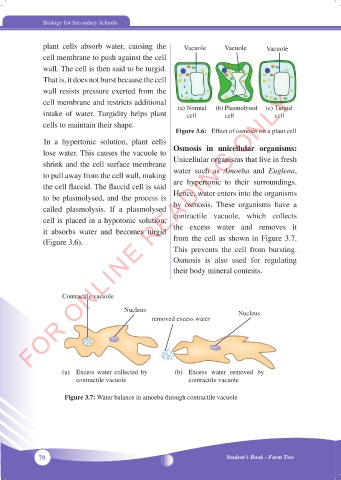
              plant cells absorb water, causing the      Vacuole     Vacuole      Vacuole
              cell membrane to push against the cell
              wall. The cell is then said to be turgid.
              That is, it does not burst because the cell
              wall resists pressure exerted from the
          FOR ONLINE READING ONLY
              cell membrane and restricts additional
              intake  of  water. Turgidity  helps  plant   (a) Normal   (b) Plasmolysed  (c) Turgid
                                                                                    cell
                                                          cell

                                                                     cell
              cells to maintain their shape.
                                                      Figure 3.6:   Effect of osmosis on a plant cell
              In a  hypertonic  solution,  plant  cells
              lose water. This causes the vacuole to   Osmosis in  unicellular  organisms:
              shrink and the cell surface membrane   Unicellular organisms that live in fresh
              to pull away from the cell wall, making   water  such as  Amoeba and  Euglena,
              the cell flaccid. The flaccid cell is said   are  hypertonic to their  surroundings.
              to be plasmolysed, and the process is   Hence, water enters into the organisms
              called  plasmolysis. If a plasmolysed   by  osmosis. These  organisms have a

              cell is placed in a hypotonic solution,   contractile  vacuole,  which  collects
              it absorbs water and becomes  turgid   the  excess water  and  removes  it
              (Figure 3.6).                          from the cell as shown in Figure 3.7.
                                                     This prevents the  cell  from bursting.
                                                     Osmosis  is also used for regulating
                                                     their body mineral contents.


                    Contractile vacuole

                                       Nucleus                           Nucleus
                                               removed excess water


                    (a)  Excess water collected by    (b)  Excess  water  removed  by
                        contractile vacuole               contractile vacuole

                     Figure 3.7: Water balance in amoeba through contractile vacuole


             70                                                      Student’s Book - Form Two


                                                                                          05/10/2024   15:36:26
     BIOLOGY FORM 2 NEW.indd   70                                                         05/10/2024   15:36:26
     BIOLOGY FORM 2 NEW.indd   70

